Alberta limits a worker's noise exposure to 85 dBA averaged over 8 hours. Above 82 dBA, the employer needs a noise exposure assessment. Here is what the OHS Code asks for, from assessments to hearing tests to choosing and fitting hearing protection.
Short answer: in Alberta, a worker's noise exposure must not go over 85 dBA averaged over an 8-hour shift. Louder noise is allowed only for shorter times, and the allowed time halves for every 3 dB increase. If noise at your site may be above 82 dBA, the OHS Code requires a noise exposure assessment.
Where the assessment shows workers are exposed to excess noise, the employer needs a noise management program. That program covers noise controls, hearing protection, training, warning signs and regular hearing tests. This guide walks through each piece in plain words.
Key facts about noise and hearing protection in Alberta
- Noise rules sit in Part 16 of the Alberta OHS Code, with the exposure limits in Schedule 3, Table 1.
- The limit is 85 dBA over 8 hours. At 88 dBA the limit is 4 hours, at 91 dBA it is 2 hours, and at 115 dBA or more no exposure is allowed.
- A noise exposure assessment is required when workers are or may be exposed above 82 dBA.
- Assessments must be done by a competent person, updated when things change, and kept for at least three years.
- Warning signs are required in work areas where noise is over 85 dBA.
- Hearing protection must meet CSA Standard Z94.2 and be fit tested to each worker.
- Exposed workers get a baseline hearing test within six months, another within 12 months of that, then at least every two years, paid for by the employer.
- Noise-induced hearing loss is a notifiable disease under the Alberta OHS Act.
What is the occupational noise exposure limit in Alberta?
The Alberta limit is 85 dBA Lex, which means an average of 85 A-weighted decibels over an 8-hour workday. The employer must keep every worker's exposure at or below that level and within the time limits in Schedule 3, Table 1 of the OHS Code.
Alberta uses a 3 dB exchange rate. Every 3 dB increase doubles the sound energy, so the safe exposure time is cut in half. The table in the Code looks like this:
- 82 dBA: 16 hours
- 85 dBA: 8 hours
- 88 dBA: 4 hours
- 91 dBA: 2 hours
- 94 dBA: 1 hour
- 97 dBA: 30 minutes
- 100 dBA: 15 minutes
- 115 dBA and above: no exposure allowed
Levels in between are prorated. The point to remember is how fast the time drops. A grinder or a chop saw can easily sit in the high 90s, so a worker can reach a full day's dose in well under an hour without protection.
The Code also expects employers to reduce noise wherever reasonably practicable, not just to stay under the limit. New work areas, major renovations, new processes and significant new equipment should be designed so continuous noise stays at or below 85 dBA, or as low as reasonably practicable.
When does an employer need a noise exposure assessment?
An employer needs a noise exposure assessment whenever workers are, or may be, exposed to noise above 82 dBA Lex. The 82 dBA trigger sits below the 85 dBA limit on purpose, so noise is measured before anyone is over-exposed.
A simple warning sign, according to Alberta OHS, is when people have to raise their voices to be heard over background noise. If that happens at your site, plan an assessment.
- The assessment follows CSA Standard Z107.56, Measurement of noise exposure.
- It must be done and interpreted by a competent person trained in noise measurement and in calibrating and using the equipment. That can be your own staff if they are competent, or an outside occupational hygiene provider.
- It must be updated when changes at the site affect noise levels or how long workers are exposed, such as new equipment, a new process or longer shifts.
- Results must be available to affected workers and OHS officers, and kept for at least three years.
Noise should also appear in your formal hazard assessment (FHA). The noise assessment gives you the numbers, and the FHA records the hazard, the controls and who is responsible. If you are building or updating hazard assessments, our guide on what a formal hazard assessment is will help.
Train your crew on hearing protection
A 15-minute online course on how noise damages hearing and how to choose, fit and care for earplugs and earmuffs. 80% to pass, printable certificate.
See Hearing Protection TrainingWhat must a noise management program include?
If the assessment confirms workers are exposed to excess noise, the employer must write and put in place a noise management program. In Alberta the program must include:
- Procedures for dealing with noise, measuring worker exposure, and teaching workers about the hazards of noise.
- The work areas where noise might exceed the exposure limits.
- The noise control methods you will use.
- Training workers in the correct use of noise controls and hearing protection.
- How hearing protection is selected, used and maintained.
- Warning signs in any work area where noise exceeds 85 dBA.
- Audiometric testing requirements and how test records are kept.
- An annual review of the program that considers the hearing test data and any concerns from the physician or audiologist.
Controls come before earplugs. Follow the usual order: remove or replace the noise source, then engineering controls such as enclosures, mufflers, damping and maintenance, then administrative controls like limiting time in loud areas, and finally hearing protection. Hearing protection is the last line of defence because it only works when it is worn and fitted well.
Training is the piece many small employers miss. The program must train workers on hearing protection, and you will want a record of it. A short online course such as our Hearing Protection Training gives each worker the basics and a certificate for your files. Pair it with a toolbox talk on your own site's loud areas and controls.
What are the audiometric testing requirements in Alberta?
Workers who are or may be exposed to excess noise must get hearing tests paid for by the employer. The schedule is a baseline test, a second test within 12 months, then a test at least every two years.
- Baseline test: as soon as reasonably practicable, and no later than six months after the worker is hired, or six months after a change in duties or process exposes them to excess noise.
- Second test: no more than 12 months after the baseline.
- Ongoing tests: at least every second year after that.
- Testing is done by an audiometric technician working with a physician, audiologist or occupational health nurse who knows the work site, following CSA Standard Z107.6.
- Workers are deemed to be at work while travelling to, from and taking the test.
If a test shows a significant threshold shift, meaning a real drop in hearing, the technician must tell the worker within 30 days and send the results to a physician or audiologist for review. The physician or audiologist gives the employer yearly group results with no names attached. That data is one of the best ways to see whether your noise controls and hearing protection are working.
Noise-induced hearing loss is a notifiable disease under section 30 of the Alberta OHS Act, so confirmed cases are reported to the province by the physician or audiologist.
How do you choose the right hearing protection?
Choose hearing protection that meets CSA Standard Z94.2, brings the worker's exposure below the limit, and that the worker will actually wear all shift. In Alberta, every device must also be fit tested to the worker using the manufacturer's method.
Most packaging shows a Noise Reduction Rating (NRR). The NRR is a lab number, and real-world protection is usually much lower. The Canadian Centre for Occupational Health and Safety suggests de-rating it: expect about half the NRR from earplugs and about 70% from earmuffs, then subtract a few more decibels. Treat a high NRR as a ceiling, not a promise.
More is not always better. Too much protection can make it hard to hear alarms, backup beepers and co-workers. The aim is to bring exposure safely under the limit while keeping workers able to communicate. Your noise assessment results should guide the level of protection you pick.
Things to weigh when choosing
- The noise level and how long workers are exposed.
- Heat, dust and moisture at the job.
- Other PPE, such as hard hats, safety glasses and respirators, which can break an earmuff seal.
- Whether workers need to hear alarms, radios or spoken instructions.
- Comfort and fit for each person, since ear canals vary a lot.
- Hygiene, and how easy the device is to clean or replace.
Earplugs or earmuffs: which is better?
Neither is always better. The best hearing protector is the one that fits the worker, suits the job and gets worn the whole time they are in noise.
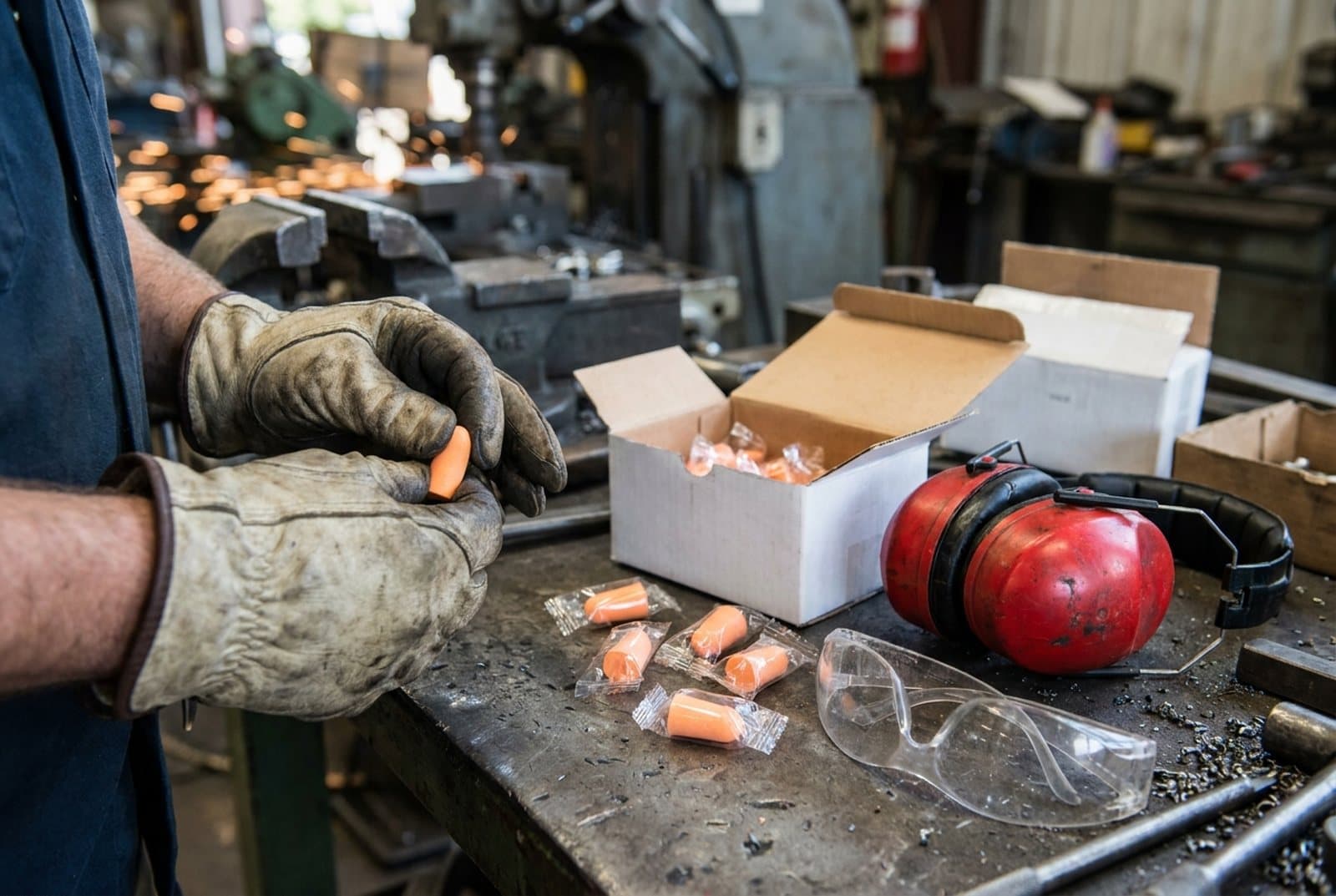
Earplugs
- Small, light and comfortable in heat.
- Work well with hard hats, glasses and respirators.
- Fit depends heavily on insertion. A poorly inserted foam plug gives much less protection.
- Harder for a supervisor to see at a glance whether they are in.
- Disposable foam plugs should be inserted with clean hands and replaced often.
Earmuffs
- Easier to fit the same way every time, and easy to see from across a shop.
- Good for workers moving in and out of noisy areas.
- Can be hot and heavy, and glasses arms or hair can break the seal.
- Cushions wear out and need replacing.
In very loud work, some employers use dual protection: earplugs and earmuffs together. CCOHS notes that doubling up adds only a few decibels over the better single device, so it is not twice the protection.
How do you fit earplugs and earmuffs properly?
A good fit means a full seal. Without a seal, even a high-rated device lets noise straight through.
Foam earplugs
- Wash or clean your hands.
- Roll the plug into a thin, tight cylinder.
- Reach over your head with the opposite hand and pull the top of your ear up and back to straighten the canal.
- Insert the plug well into the canal and hold it for 20 to 30 seconds while it expands.
- Check the fit: your own voice should sound deeper and outside noise should be muffled.
Earmuffs
- Tuck hair away and keep glasses arms as thin as possible under the cushions.
- Place the cups fully over both ears and adjust the band so the cushions press evenly.
- Check cushions for cracks or hardening and replace them when worn.
Wear protection for the whole time you are in noise. Taking it off for even a few minutes in a loud area uses up a big share of the day's allowed dose. That is why fit and comfort matter so much: people keep wearing gear that feels right.
Give every worker the basics in 15 minutes
Hearing Protection Training covers hearing loss, types of protection, and how to choose, fit and maintain it. Online, $29.99 per seat.
Start Hearing Protection TrainingIs online training enough?
Online training covers the knowledge part: why noise matters and how hearing protection works. It does not replace the employer's other duties. In Alberta the employer must still fit test each worker's hearing protection, run the noise management program, and arrange hearing tests. Supervisors should also check on the job that workers are wearing protection correctly.
Other provinces and federally regulated workplaces have their own noise limits and testing rules, so check your own jurisdiction if you work outside Alberta. If you want help building noise into your safety program or hazard assessments, our safety experts can help.
Related training and guides
- Hearing Protection Training (online course)
- Personal Protective Equipment for Employees (PPE)
- What is a formal hazard assessment?
- Online safety training for your team
- Talk to our safety experts
Frequently asked questions
What is the noise exposure limit in Alberta?
Alberta's occupational noise exposure limit is 85 dBA averaged over 8 hours, set in Part 16 and Schedule 3, Table 1 of the OHS Code. Higher levels are allowed only for shorter times, halving for every 3 dB.
When is a noise assessment required in Alberta?
An Alberta employer must have a noise exposure assessment done when workers are or may be exposed to noise above 82 dBA Lex. It must be done by a competent person and kept for at least three years.
At what decibel level is hearing protection required in Alberta?
Alberta does not use a single decibel trigger for hearing protection. Exposure must stay within 85 dBA over 8 hours, and where workers are exposed to excess noise the employer's noise management program sets out the hearing protection they must wear.
How often do workers need hearing tests in Alberta?
Alberta workers exposed to excess noise need a baseline hearing test within six months, another within 12 months of the baseline, and then at least every two years. The employer pays.
What standard must hearing protection meet in Alberta?
Hearing protection used in Alberta workplaces must meet CSA Standard Z94.2, Hearing protection devices - Performance, selection, care, and use, and must be fit tested to each worker.
Is the NRR on earplugs accurate?
The Noise Reduction Rating is a lab result. Real-world protection is usually lower, so safety guidance suggests de-rating it, roughly half the NRR for earplugs and about 70% for earmuffs.
Are earplugs or earmuffs better for noise?
Neither is always better. Earplugs suit heat and other PPE but depend on good insertion. Earmuffs fit more consistently and are easy to check. Choose the protector that fits the worker and gets worn all shift.
Does online hearing protection training meet Alberta requirements?
Online hearing protection training covers the knowledge part of the training an Alberta noise management program requires. The employer must still fit test each worker's hearing protection and arrange hearing tests.