Insights
What is COR (Certificate of Recognition)?
A COR (Certificate of Recognition) is a verification that an employer's occupational health and safety management system meets the protocol of a recognised certifying partner. It is issued by a provincial Workers' Compensation Board and audited by accredited third-party auditors. Most Canadian public-sector prime contractors and major project owners require COR as a condition of bidding.
Published 11 May 2026 · Updated 13 May 2026 · The On-Track Team
7 min readKey Takeaways
- COR is a voluntary certification but effectively mandatory for any operator bidding into public-sector or prime-contractor work across Canada.
- Each province runs its own COR program through its Workers' Compensation Board -- certifying partners, worker thresholds, and rebate amounts all differ.
- The standard pass threshold is 80% overall and at least 50% in every individual element; a low element score is a hard fail regardless of the overall total.
- COR operates on a three-year cycle -- initial certification, two maintenance audits, then a recertification audit -- with at least the initial and recertification audits conducted externally.
- Alberta’s PIR rebate offers up to 20% of annual WCB premiums back to COR-certified operators -- for a company paying $500K in premiums, that is $100K per year.
- The most common reason operators fail is that the safety program lives on paper but not in practice -- auditors test worker knowledge, not just the manual.
1. What COR actually is
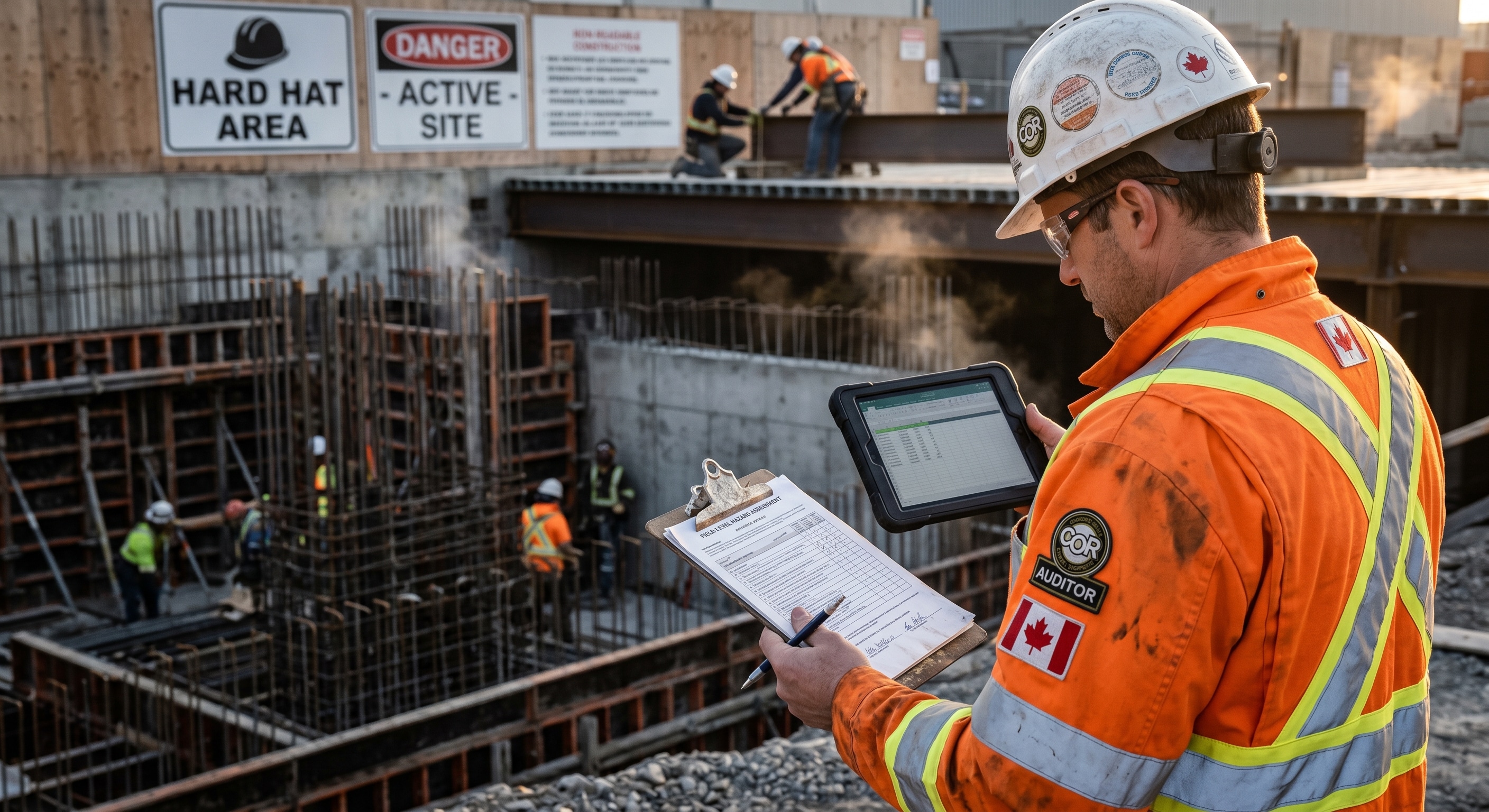
A Certificate of Recognition (COR) is a written verification that an employer has built and is running an occupational health and safety management system that meets a defined audit protocol. The protocol covers policy, hazard assessment and control, safe work practices and procedures, training and orientation, inspection, investigation and reporting, emergency response, records, and program review. Every element has documented evidence requirements; the audit scores each element against the evidence the company can produce.
The certificate is not a one-time achievement. It is a three-year licence, renewed by maintenance and recertification audits, that signals to prime contractors and project owners that the company runs a safety program that produces a defensible paper trail. The COR framework was created by the Canadian Federation of Construction Safety Associations in partnership with provincial Workers' Compensation Boards in the 1990s and has expanded to cover most industries beyond construction since then.
2. Who issues it
In Canada, COR certificates are issued by provincial Workers' Compensation Boards (or equivalent regulators) and audited on their behalf by accredited certifying partners. Each province has its own COR program managed under the Canadian Federation of Construction Safety Associations framework, so the certificate is recognised across jurisdictions even though each province maintains its own register.
In Alberta, the WCB issues the certificate. ACSA (Alberta Construction Safety Association) audits the construction sector. Energy Safety Canada (ESC) audits upstream oil and gas and accepts multi-province cross-jurisdictional audits. AASP (Alberta Association for Safety Partnerships) audits a broad range of industries outside construction and energy. Manufacturing, transportation, and several other sector partners cover their respective industries. The right certifying partner depends on the industry, where the work is performed, and which prime contractor platforms the company is registered with.
3. COR by province
Each Canadian province runs its own COR program through its Workers' Compensation Board (or equivalent regulator) and one or more accredited certifying partners. The certificate is recognised across jurisdictions under the Canadian Federation of Construction Safety Associations framework, but the worker thresholds, certifying partners, training requirements, and WCB rebate mechanisms differ. The province-by-province reference below covers Alberta, British Columbia, Saskatchewan, Manitoba, Ontario, New Brunswick, and the Atlantic / Northern jurisdictions.
Alberta
- WCB / Issuer
- WCB Alberta (PIR)
- Worker threshold
- COR 10+ workers, SECOR 10 or fewer
- Main certifying partners
- AASP, ACSA, ESC, AMTA, AMHSA plus 8 more
- WCB incentive
- 5% typical, up to 20% premium rebate
British Columbia
- WCB / Issuer
- WorkSafeBC
- Worker threshold
- COR 20+ workers, Small COR 19 or fewer
- Main certifying partners
- BCCSA, go2HR, BC Forest Safety Council, ESC
- WCB incentive
- 10% of base assessment premiums
Saskatchewan
- WCB / Issuer
- Saskatchewan WCB
- Worker threshold
- COR 10+ workers, SECOR 9 or fewer
- Main certifying partners
- SCSA, HCSAS, ESC
- WCB incentive
- No direct COR-linked rebate
Manitoba
- WCB / Issuer
- WCB Manitoba / SAFE Work
- Worker threshold
- All sizes (COR and SECOR available)
- Main certifying partners
- CSAM, MHCA WORKSAFELY
- WCB incentive
- 15% of premium or $3,000, whichever is greater (max 50%)
Ontario
- WCB / Issuer
- WSIB Ontario
- Worker threshold
- All sizes (no separate SECOR program)
- Main certifying partners
- IHSA (sole authority for COR in Ontario)
- WCB incentive
- WSIB HSEp: fixed $/topic, not a percentage
New Brunswick
- WCB / Issuer
- WorkSafeNB
- Worker threshold
- All sizes (construction-industry focus)
- Main certifying partners
- NBCSA
- WCB incentive
- No direct COR-linked rebate
NL / NWT / Nunavut
- WCB / Issuer
- WorkplaceNL or WSCC
- Worker threshold
- All sizes (construction and related)
- Main certifying partners
- NLCSA in NL, NSA-NT in NWT and Nunavut
- WCB incentive
- PRIME: 5% flat practice refund (NL) - COR is the qualification gate, not the payment
Quebec runs its own occupational health and safety regime through CNESST and does not participate in the national COR program. On-Track operates across the nine COR jurisdictions listed above; we do not provide French-language audits.
4. Who needs COR
COR is not legislated as mandatory anywhere in Canada. It is voluntary at the regulator level. But for any operator bidding into the public sector or working under a tier-one prime contractor, COR is effectively required. Most provincial governments, large municipal employers, and major private prime contractors write COR into their prequalification criteria. Without it, those bids are not considered.
The typical Canadian operator who needs COR is a 15 to 200 employee company in construction, oil and gas, transportation, trades, industrial, manufacturing, mining, or municipal contracting, bidding into prime contractor or public-sector work. Companies with fewer than 10 employees often pursue SECOR (Small Employer Certificate of Recognition) instead, which is a lighter-touch program with a shorter audit. The threshold is not strictly worker-count; it is whether the prime contractor or owner accepts SECOR. Most do.
5. What the audit looks like
A COR audit is two to three days on site plus five to seven business days for the scored report. The auditor reviews the company's safety program documentation against the certifying partner protocol, interviews a representative sample of workers and supervisors using the protocol's question set, and observes work in progress at one or more sites. Every element of the protocol is scored against documented criteria. The auditor flags gaps in real time so the company knows where to expect corrective actions before the report is finalised.
The pass threshold varies by certifying partner but typically sits at 80% overall with a 50% minimum on every individual element. A perfectly scored documentation review that fails the interview portion because workers cannot describe the program is a real failure pattern; the audit measures whether the program is on paper AND in the field. After the certificate is issued, the company moves into the three-year cycle of maintenance and recertification audits described in the FAQ below.
Audit score trend
3-year cycle
On-Track is certified by both ACSA and ESC. Dual certification is uncommon in Canadian auditing. It lets one team cover most of the certifying partner landscape our clients operate under, without handoffs between auditors who have only seen part of the picture. See how our COR audits work
6. COR vs SECOR
COR is the full Certificate of Recognition program. SECOR is the Small Employer Certificate of Recognition, designed for smaller operators (typically under 10 employees) whose program scope and audit evidence requirements are proportionally smaller. SECOR uses a self-audit format with certifying-partner oversight; COR uses an external auditor for at least the initial and recertification audits.
Picking the wrong one wastes money and time. SECOR for an operation that has outgrown the small-employer scope produces a certificate that prime contractors may not accept. COR for a four-person sole-proprietor operation is overscoped for the actual work. The decision hinges on (1) the company's worker count, (2) which prime contractor platforms it is registered with, and (3) whether the work involves multi-province or multi-jurisdictional scope. A full comparison is coming in a separate article.
Book your auditor before your program is complete
7. How to prepare
The 90-day, 30-day, audit-week structure works for most operators. At 90 days out, the company confirms the certifying partner, scopes the audit (single province vs multi-province, sector, worker sample), and runs a gap review against the protocol. At 30 days out, the documentation should be final, training records caught up, inspections current, and the JHSC minutes up to date. Audit week itself is about staying out of the auditor's way while making sure the right people and records are accessible.
The single biggest factor in passing on the first attempt is not the documentation. It is whether the worksite practice matches what the documentation describes. Auditors recognise template language quickly. They look for the gap between what the manual claims and what they observe on site. A custom safety manual built around the company's actual operations, supported by training records and inspection logs from the months before the audit, closes that gap before it opens.
8. Download the reference PDF
The full Canadian COR Program reference in a print-ready PDF. Everything on this page, plus the province-by-province table in a one-page reference layout. Built for safety leads who want a defensible reference at their desk during audit prep.
The Canadian COR Program reference
One PDF, every Canadian COR jurisdiction. Definition, 4-step process, province-by-province comparison, what the audit covers, and how On-Track supports it.
No email required. Print and share.
Our Services
Preparing for your first COR audit?
On-Track Safety conducts external COR audits for ACSA and ESC certifying partners, and builds custom safety manuals tailored to your industry, province, and scope of work.
See COR audit details9. Frequently asked
Who issues a COR certificate?
COR is issued by provincial Workers' Compensation Boards or equivalent regulators, audited on their behalf by accredited certifying partners. In Alberta, the WCB issues the certificate; ACSA, Energy Safety Canada, and several other partners conduct the audits. Each province has its own COR program managed under the Canadian Federation of Construction Safety Associations framework, so the certificate is recognised across jurisdictions even though each province maintains its own register.
Is COR mandatory in Canada?
COR is not legislated as mandatory anywhere in Canada, but many public-sector prime contractors and major project owners require it as a condition of bidding. Provincial governments, large municipal employers, and tier-one private prime contractors commonly write COR into their prequalification criteria. For operators bidding into those tiers, COR is effectively mandatory even though it is technically voluntary.
How long does it take to get COR?
From decision to certificate is typically six to twelve months for a company starting from scratch: two to three months to build or update the safety program documentation, three to six months to implement the program on the worksite and generate the records the audit needs, then two to three days on site for the audit and five to seven business days for the report. Companies with a mature safety program already in place can compress this timeline.
What is the COR three-year cycle?
After the initial certification audit, the COR certificate is valid for three years. Each year of the cycle requires a maintenance audit. Depending on the certifying partner, years two and three may accept internal maintenance audits while the recertification audit in year three is always external. Internal audits are conducted by company personnel trained by the certifying partner; external audits are conducted by accredited third-party auditors.
What is the difference between internal and external audits?
Internal audits are conducted by company personnel who have completed the certifying partner's internal auditor training. They score the program against the same protocol an external auditor uses. External audits are conducted by accredited third-party auditors who are independent of the company. Both produce a scored report and corrective action list. The recertification audit at the end of each three-year cycle must be external, regardless of certifying partner.
What happens if a company fails a COR audit?
Failing a COR audit means scoring below the certifying partner's pass threshold (typically 80% overall and 50% in every element). The company does not lose existing COR status mid-cycle on a maintenance audit, but the corrective actions must be addressed and a re-audit may be required. On an initial certification audit or recertification audit, failing means the certificate is not issued or not renewed; the company can re-audit after addressing the gaps, typically within six months.