
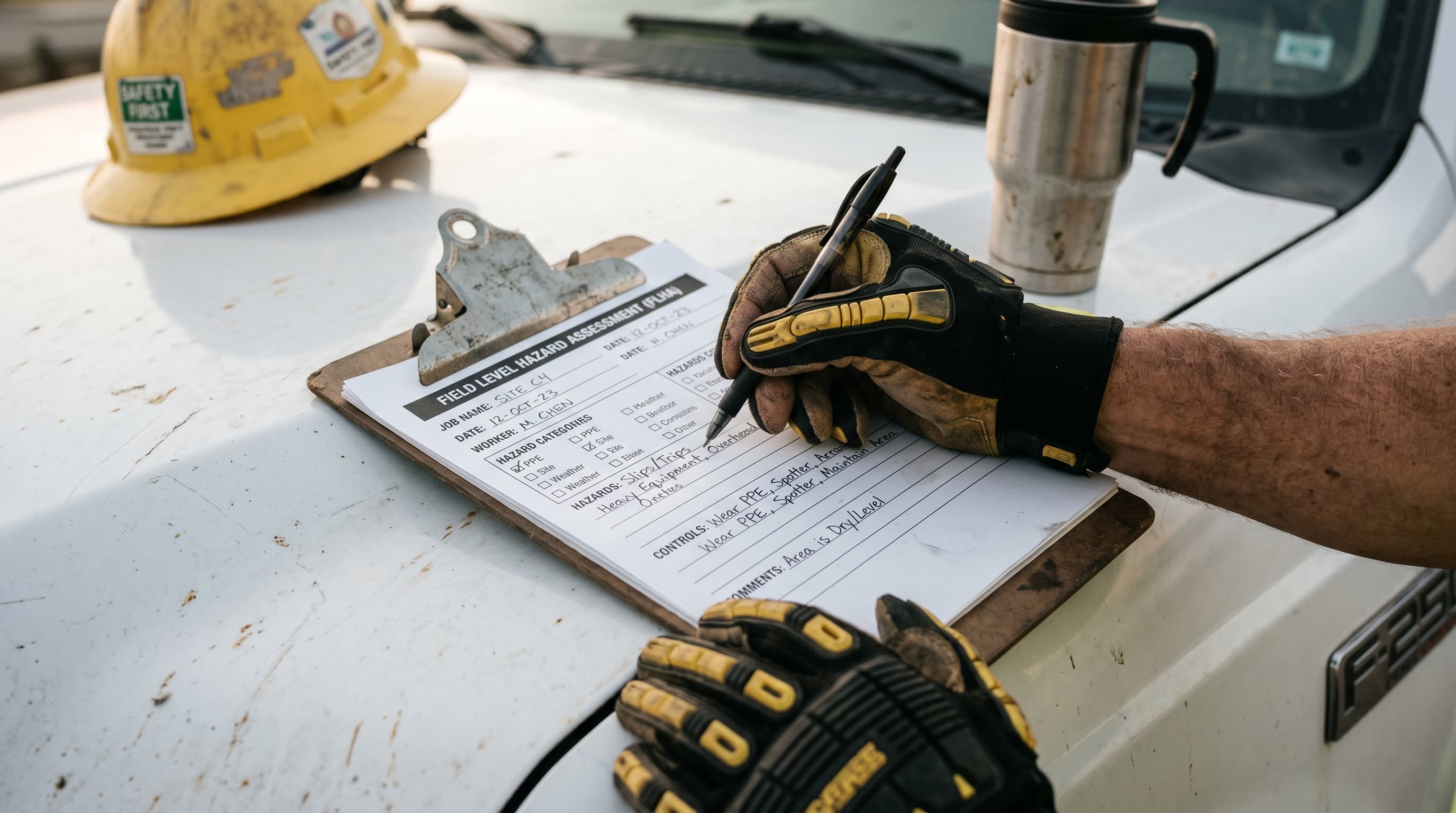
A step-by-step walkthrough for building a formal hazard assessment program from scratch: how to inventory tasks, rate severity and likelihood, assign controls through the hierarchy, and get sign-off that actually holds up.
A formal hazard assessment (FHA) is the document that turns "we're careful out there" into something an auditor, a new hire, or a prequalification reviewer can actually read and trust. If your company has never built one, the blank page is the hardest part. This post walks through the process in order: identify the tasks, break them into steps, rate the hazards, assign controls, get sign-off, and keep the document alive after it's written.
This is not a theory piece on why FHAs matter or a shortcut guide for fixing a program that already exists and has gone stale. It is the build-from-zero sequence: what to do first, second, and third if your company has no formal hazard assessment process today.
Start With a Task Inventory, Not a Template
The most common mistake is downloading a generic FHA template and trying to fill in blanks before you know what you are assessing. Start instead with a plain list of every distinct task your workers perform, department by department. A road maintenance crew and an office administrator do not share a task list, and neither do a welder and a flagger on the same job site.
Walk the work, do not just ask about it. Talk to the people doing the job, not only the supervisor describing it from memory. A task inventory built entirely from a manager's desk will miss the shortcuts, workarounds, and edge cases that actually create risk on site.
- List tasks by job title or crew, not by department name alone
- Include occasional and seasonal tasks (confined space entry twice a year still needs an assessment)
- Note where a task changes meaningfully by site, weather, or equipment used
- Flag any task already tied to a permit (hot work, confined space, working at heights)
Break Each Task Into Steps and Name the Hazards
Once you have the task list, pick one task and break it into its sequential steps, the way you would explain it to someone doing it for the first time. For each step, name the specific hazard, not a category. "Struck-by hazard from swing radius while operator backs excavator near the trench edge" is usable. "Equipment hazards" is not.
Cover the full range of hazard types as you go: physical (noise, vibration, moving equipment), chemical (anything covered under WHMIS 2015, including product in a container that has been relabelled), ergonomic (repetitive motion, awkward lifts), biological, and psychological (fatigue, isolated work). It is normal for a single task to carry hazards from more than one category.
If a task already has a documented safe work procedure, do not skip the hazard assessment step because the procedure exists. Pull the hazards straight out of the procedure and confirm they still match how the work is actually done today.
Assess Severity and Likelihood for Each Hazard
This is the step that turns a hazard list into a formal hazard assessment. For every hazard identified, rate two things separately: how bad the outcome could be, and how likely it is to happen given current conditions.
Severity
Rate the realistic worst-case outcome, not the average outcome. A fall from a ladder might usually mean a bruise, but the realistic worst case is a serious injury or fatality, and that is the number that should drive the rating. Most companies use a simple three or five-point scale (minor, serious, major or catastrophic) rather than inventing something elaborate. Consistency across the document matters more than the number of levels you choose.
Likelihood
Rate how often the hazard is likely to occur given the controls already in place, not the controls you plan to add later. Consider frequency of exposure, the condition of equipment, worker experience level, and site-specific factors like weather or traffic. A task performed daily by a new hire carries a different likelihood than the same task performed monthly by a fifteen-year veteran.
Multiply or combine severity and likelihood on a simple risk matrix to get a priority ranking. This ranking is what tells you where to spend your control budget and attention first: high severity and high likelihood items go to the top of the list regardless of how simple or complex the fix looks.
Assign Controls Using the Hierarchy
For every hazard rated above your acceptable threshold, assign a control, and work down the hierarchy of controls in order rather than reaching for PPE first because it is cheapest and fastest.
- Elimination: remove the hazard entirely (reroute traffic away from a task instead of working beside it)
- Substitution: replace the hazardous material, tool, or method with a less hazardous one
- Engineering controls: guards, ventilation, barriers, automated shutoffs
- Administrative controls: procedures, signage, training, job rotation, permits
- Personal protective equipment: the last line of defence, not the first
Write down which control level you chose and why, not just the control itself. This record is what a COR or SECOR auditor, or a client's prequalification reviewer on a platform like ISNetworld or Avetta, will look for when they check whether hazard assessments were actually used to drive decisions rather than filled out after the fact.
Get Worker Sign-Off and Document It
An FHA that no one on the crew has seen is not a hazard assessment, it is a filing cabinet document. Review the completed assessment with the workers who perform the task, before the work starts, and capture sign-off with names, dates, and the specific job or site the assessment applies to.
Sign-off is not a formality for the auditor. It is the point where the worker confirms the hazards listed match reality and the controls listed are actually available and usable on site. If a worker flags a hazard or a missing control during that review, the assessment needs to be corrected before work begins, not noted for later.
Keep It Alive After Day One
A formal hazard assessment is a working document, not a one-time deliverable. Set a trigger list for when an existing FHA must be reviewed: a near-miss or incident tied to the task, a change in equipment or materials, a new hazard identified on site, or a fixed review interval such as annually. Build the review trigger into your safety manual so it does not depend on someone remembering.
Companies building this process for the first time often do it alongside a broader safety manual build, since the FHA template, the hierarchy of controls, and the sign-off record all need to live somewhere consistent. If you want a second set of eyes on your task inventory or your first completed assessments before you roll them out, that is exactly the kind of review our field safety and safety manual services are built around.