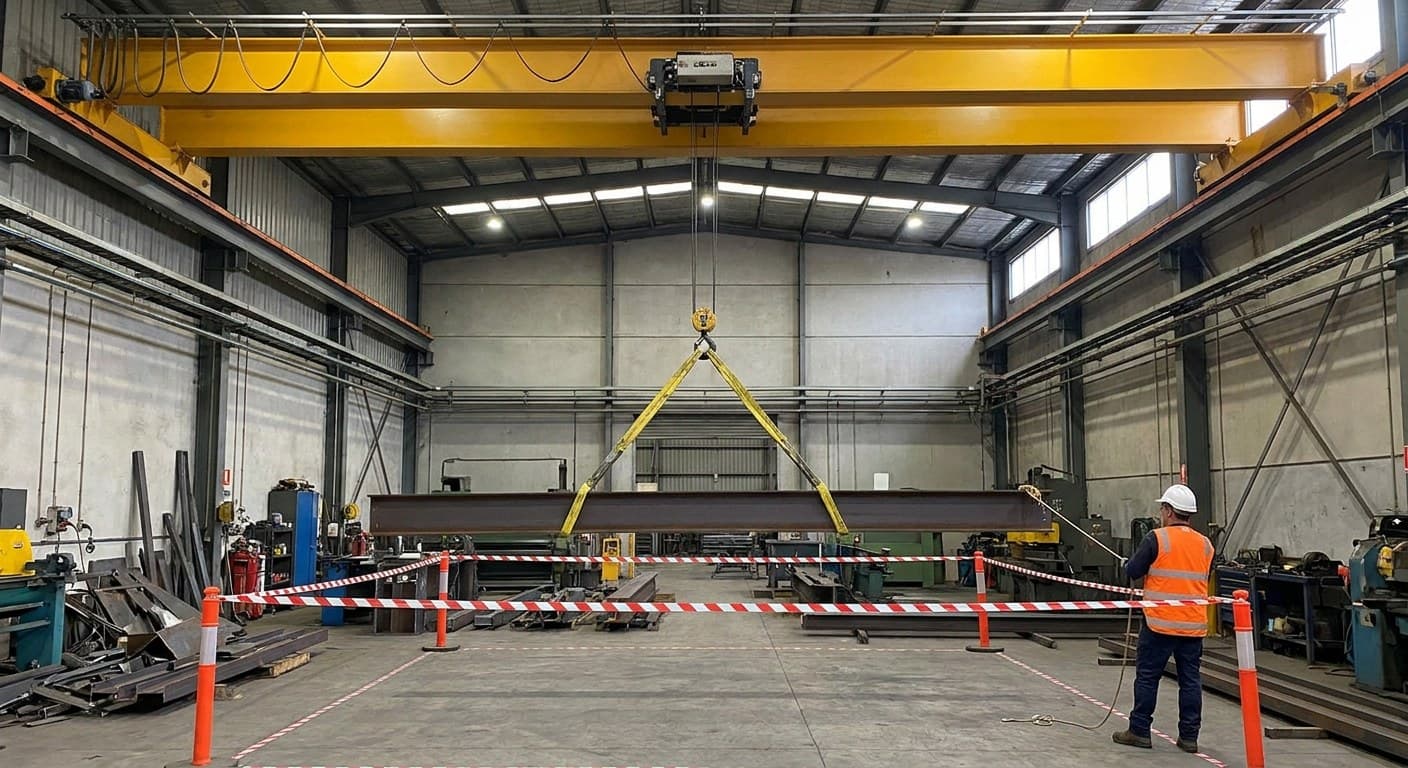
In Alberta, an overhead crane may only be run by a competent worker the employer has authorized. Online training covers the knowledge, but the employer still has to evaluate each operator on the job. Here is what the OHS Code says about cranes and rigging, and how to pick the right course.
Short answer: in Alberta, an overhead crane operator must be a competent worker who has been authorized by the employer. When asked, the operator has to show they can run the crane, read its load chart and use the code of signals. There is no single government crane card for overhead cranes. It is up to the employer to train, evaluate and authorize each operator.
Most overhead crane operators also rig their own loads, and Alberta has a separate set of rules for rigging. A complete qualification is usually theory training on both crane operation and rigging, then a hands-on evaluation on the crane the worker will actually use.
Key facts about overhead crane and rigging training in Alberta
- Overhead cranes are lifting devices under Part 6 of the Alberta OHS Code (Cranes, Hoists and Lifting Devices).
- Only a competent worker authorized by the employer may operate a lifting device (section 64).
- On request, the operator must show competence in operating the crane and knowledge of load charts and the code of signals.
- Each lifting device needs a log book, except manually operated hoists, and the operator must know its recent entries (sections 64 and 65).
- Overhead cranes must meet the CSA B167 standard for maintenance and inspection (section 94).
- Rigging is covered by Part 21. It must be inspected before each period of continuous use during a shift (section 294).
- Slings must meet ASME B30.9, and below-the-hook lifting devices must meet ASME B30.20 (section 297).
- An online course covers the knowledge part. The employer still has to evaluate competency on the job.
What does the Alberta OHS Code require of an overhead crane operator?
The Code requires that the operator be competent and authorized, and that nobody else runs the crane. Section 64 of the OHS Code puts the duty on the employer: a lifting device may only be operated by a competent worker the employer has authorized to operate it. No other worker may operate it.
The same section says that, at the employer's request, the operator must be able to show they are competent in the crane's operation and know the load charts and the code of signals for hoisting. Before operating a particular crane, the operator must also be familiar with the recent entries in its log book.
A few other Part 6 rules shape everyday overhead crane work. If the operator has any doubt about the safety of workers near a lift, they must not move the load until conditions are safe (section 66). Work must be arranged, where reasonably practicable, so loads do not pass over workers (section 69). The operator, the rigger and the person in charge of the lift must be given the information they need to work out the weight of the load (section 68). Overhead crane controls must be the constant manual pressure type, so the crane stops when the operator lets go (section 95.1).
'Competent' has a specific meaning in Alberta law. It means adequately qualified, suitably trained and with enough experience to do the work safely with little or no supervision. A certificate alone does not prove that. Training plus an evaluation on the job does.
Train crane operation and rigging in one course
Overhead Crane & Rigging Level 1 covers crane types, pre-use checks, safe operation, slings, hardware, hitches and lift planning, with competency assessment forms included.
See the courseWho is allowed to rig a load?
Anyone who rigs a load should be trained in rigging and competent to do it, and in a shop that is often the crane operator. Part 21 of the OHS Code does not create a separate rigger licence. It sets rules for the rigging itself, and those rules only work if the person choosing and inspecting the rigging knows what they are looking at.
Section 68 of Part 6 mentions 'the rigger supervised by the operator', which reflects how many lifts work in practice. The operator is in charge of the crane. The rigger picks the slings and hardware, attaches them, and guides the load. On a small overhead crane, one person often does both. Either way, the employer should be able to show that whoever rigs the load was trained and evaluated.
Part 21 rules every rigger should know include these:
- The maximum load rating of rigging must be clearly marked on it, or made available at the work site if marking is not practicable (section 293).
- Rigging must be inspected thoroughly before each period of continuous use during a shift (section 294).
- A worker must not use rigging that does not comply with Part 21 (section 295).
- Sharp edges on a load must be guarded so they do not cut slings (section 296).
- Hooks need a safety latch, mousing or shackle if a dislodged hook could hurt someone, with limited exceptions (section 303).
- No makeshift fittings, and no welded repairs to rigging unless a professional engineer certifies them after the repair (section 304).
How do you inspect a sling, and when do you reject it?
Inspect every sling before each period of continuous use, and take it out of service if its tag is missing or it shows any of the damage listed in the Code or by the manufacturer. Alberta sets rejection criteria for synthetic fibre slings, wire rope, metal mesh slings, electric arc damage and damaged hooks in sections 305 to 309.
At a general level, a pre-use sling check looks like this:
- Check the tag. A synthetic sling must be marked with the maker's name or trademark, a code or stock number, and the safe working load for each type of hitch (section 298). No readable tag, no lift.
- Look along the whole length for cuts, tears, abrasion, burns, melting, snags and crushed or kinked sections.
- On wire rope, look for broken wires, kinks, birdcaging, crushing, corrosion and heat damage.
- On chain, look for stretched, bent, nicked or cracked links and worn hooks.
- Check the fittings: hooks for opening or twisting and a working latch, shackles for the right pin and no bending, eyes and end fittings for damage.
- Look for signs of electric arc or weld spatter. Arc-damaged rigging comes out of service.
- Tag and remove anything that fails, so nobody picks it up again.
The Code's criteria for synthetic web slings are detailed. For example, a web sling must be permanently removed from service if an edge cut is longer than the web is thick, or if abrasion goes deeper than 15 percent of the webbing thickness. You do not need to memorize the numbers to use a sling safely, but your inspection procedure should match the Code and the manufacturer's instructions. When in doubt, take it out of service.
Keep damaged rigging out of the crib. A rejected sling that goes back on the rack will be used again. Cut it, tag it or lock it away, and record it.
Which ASME B30 standards apply to overhead cranes and rigging?
Alberta's Code names two ASME B30 standards directly: B30.9 for slings and B30.20 for below-the-hook lifting devices. For the crane itself, the Code points to CSA B167 for maintenance and inspection. Other B30 volumes are widely used as industry practice.
- ASME B30.2 - Overhead and Gantry Cranes (top running bridge). Construction, installation, operation, inspection and maintenance.
- ASME B30.9 - Slings. Required in Alberta for wire rope, alloy chain, synthetic rope, metal mesh and synthetic fibre slings made on or after July 1, 2009 (section 297).
- ASME B30.10 - Hooks. Fabrication, use, inspection and maintenance of hooks.
- ASME B30.16 - Overhead Underhung and Stationary Hoists, including hand chain, electric and air hoists.
- ASME B30.20 - Below-the-Hook Lifting Devices, such as spreader bars and lifting beams. Required in Alberta for below-the-hook devices other than slings (section 297).
- CSA B167 - the Canadian standard for maintenance and inspection of overhead cranes, gantry cranes, monorails, hoists and trolleys. Required in Alberta (section 94).
Good training is built on these standards. Our Overhead Crane & Rigging Level 1 course was developed using current overhead crane standards and ASME rigging standards, so what a worker learns online lines up with what the Code expects.
Does online overhead crane training count?
Yes, for the knowledge part, but it does not replace the employer's evaluation. An online course is a practical way to teach crane types, inspection, signals, sling selection, hitches and load weights. It gives you a record of training and a test result.
What an online course cannot do is watch a worker run your crane in your building. The OHS Code expects a competent operator, authorized by the employer, who can demonstrate competence on request. So after the online course, a supervisor or other competent worker should watch the worker do a pre-use check, rig a load and make a lift, then record the result and authorize them in writing.
This is why the Overhead Crane & Rigging Level 1 course includes competency assessment forms for both crane operation and rigging. They give your evaluator a consistent checklist, and they give you a signed record to keep with the training certificate. A COR auditor or an OHS officer will look for both.
Evaluate again when something changes: a new crane or hoist, a new type of load, an incident or near miss, or unsafe habits spotted on the floor. Build crane and rigging hazards into your formal hazard assessment (FHA), and make sure the controls in it match what the operator was trained to do.
Should I choose a crane-only course or a crane and rigging course?
Choose by the work the person actually does. If the worker only runs the crane and someone else rigs every load, a crane-only course may be enough. If the worker rigs their own loads, which is common with overhead cranes, pick a course that covers both.
- Overhead Crane - Operator Safety (about 1.5 hours, $99.99): crane types, inspections, controls and safe operation. Best for operators who do not rig, or as a short refresher.
- Rigging - Level 1 (about 5 hours): rigging hardware, slings, hooks, manual hoists, hitches, tensions and weight calculations. Best for riggers who do not operate the crane.
- Overhead Crane & Rigging Level 1 (about 5 to 7 hours, $194.99, 70% to pass): both portions in one course, with competency assessment forms for crane operation and rigging. Best for operators who rig their own loads.
- Rigging and Slinging (Advanced): for experienced riggers handling more complex lifts.
Buying one combined course is simpler than tracking two certificates for the same worker, and the included forms save you building your own. If you are not sure which fits, our safety experts can help you match courses to the work your crew does.
Ready to train your crane operators?
Overhead Crane & Rigging Level 1 is self-paced, takes about 5 to 7 hours and includes the competency forms you need for the on-the-job evaluation.
Enrol in Overhead Crane & Rigging Level 1What about other provinces?
Every province sets its own crane and rigging rules, and the section numbers above are Alberta's. Most Canadian jurisdictions point to the same CSA and ASME standards, and all of them expect operators to be trained and competent. If your crew works outside Alberta, check that province's OHS regulation for the operator, inspection and record rules.
- Overhead Crane & Rigging Level 1 course
- Overhead Crane - Operator Safety course
- Rigging - Level 1 course
- Rigging and Slinging (Advanced) course
- Crane Load Chart Reading and Calculations course
- What is a formal hazard assessment?
- Online safety training for your team
- Talk to our safety experts
Frequently asked questions
Do you need a licence to operate an overhead crane in Alberta?
Alberta does not issue a government licence for overhead crane operators. Under the OHS Code, the employer must make sure only a competent worker it has authorized operates the crane, and the operator must be able to show competence when asked.
What must an overhead crane operator know under the Alberta OHS Code?
Section 64 of the Alberta OHS Code says the operator must be able to show competence in operating the crane, knowledge of load charts and the code of signals, and familiarity with the recent entries in the crane's log book.
How often must rigging be inspected in Alberta?
Under section 294 of the Alberta OHS Code, rigging used during a work shift must be inspected thoroughly before each period of continuous use during that shift.
Which ASME standard covers slings in Alberta?
Section 297 of the Alberta OHS Code requires slings made on or after July 1, 2009 to meet ASME B30.9. Below-the-hook lifting devices other than slings must meet ASME B30.20.
Is online overhead crane training enough?
Online overhead crane training covers the knowledge part only. The employer must still evaluate the worker on the crane they will use and authorize them before they operate it on their own.
Does an overhead crane need a log book in Alberta?
Yes. The Alberta OHS Code requires a paper or electronic log book for each lifting device at a work site, recording inspections, defects, repairs and other safety matters. Manually operated hoists are exempt.
What is the difference between a crane-only course and a crane and rigging course?
A crane-only course, such as Overhead Crane - Operator Safety, covers running the crane. A crane and rigging course, such as Overhead Crane & Rigging Level 1, also covers slings, hardware, hitches, sling tensions and lift planning, which suits operators who rig their own loads.