Canadian fire extinguishers are sorted by the class of fire they can put out: A, B, C, D and K. The rating on the label tells you how big a test fire the unit handled. This guide explains the classes and ratings, the PASS method, when to fight and when to leave, how often extinguishers are checked, and what Alberta employers need for training.
Short answer: in Canada, fire extinguishers are grouped by the class of fire they can safely put out. Class A is ordinary combustibles, B is flammable liquids and gases, C is live electrical equipment, D is combustible metals and K is cooking oils and fats. The numbers and letters on the label, such as 2A:10B:C, tell you which classes the unit is rated for and how big a fire it handled in testing.
Knowing the classes is only half the job. A worker also needs to know how to operate the extinguisher, when a fire is too big to fight, and how the workplace keeps its extinguishers ready. That is what fire extinguisher training covers.
Key facts about fire extinguishers in Canada
- There are five fire classes: A (wood, paper, cloth, rubber, many plastics), B (flammable liquids, gases, oils, paints), C (energized electrical equipment), D (combustible metals) and K (cooking oils and fats in appliances).
- Most workplace extinguishers are multi-purpose ABC dry chemical units.
- Canadian extinguishers are tested and rated to the CAN/ULC-S508 standard, and the rating is printed on the label.
- PASS stands for pull, aim, squeeze and sweep.
- Never fight a fire if you don't know what is burning, which extinguisher to use, how to use it, or if the fire is spreading.
- Extinguishers get a quick visual check every month and full servicing at least once a year.
- In Alberta, every employer must prepare and implement an emergency response plan, and workers with a role in it must be trained.
What do the fire extinguisher classes mean?
Each class describes a type of fuel. The class tells you which extinguisher is safe to use, because the wrong agent can spread a fire or put you at risk.
Class A: ordinary combustibles
Wood, paper, cardboard, cloth, rubber and many plastics. These fires leave ash. Water, foam and ABC dry chemical extinguishers work on Class A fires. The pictogram is usually a burning bin beside a campfire.
Class B: flammable liquids and gases
Gasoline, diesel, solvents, oil-based paints, lacquer, propane and similar fuels. Never use water on a Class B fire, since it can splash burning liquid and spread it. Use a unit rated for B, such as ABC dry chemical, BC dry chemical, foam or carbon dioxide. The pictogram shows a gas can and a burning puddle.
Class C: energized electrical equipment
Motors, panels, appliances, power tools and wiring that are still live. The danger is electric shock, so the agent must not conduct electricity. Carbon dioxide and dry chemical units carry a C rating. If you can shut off the power safely, do it, and the fire then becomes a Class A or B fire. The pictogram is a plug and outlet.
Class D: combustible metals
Magnesium, titanium, sodium, potassium and other reactive metals, often as shavings or powder in machine shops and labs. These fires need a special dry powder agent made for the metal on site. Ordinary extinguishers can make a metal fire worse.
Class K: cooking oils and fats
Deep fryers and commercial kitchen appliances. Class K extinguishers use a wet chemical agent that cools the oil and forms a soapy layer that smothers it. You will see them in camp kitchens, cafeterias and restaurants.
How do you read a rating like 2A:10B:C?
Read it one letter at a time. The number in front of A and B shows how large a test fire the extinguisher put out when it was rated, so a bigger number means more fire-fighting capacity. The C has no number. It simply means the agent does not conduct electricity and is safe on live equipment.
So a 2A:10B:C unit works on ordinary combustibles, flammable liquids and electrical fires, and has more capacity than a 1A:5B:C unit. If a class letter is missing, the extinguisher is not rated for that class, and you should not use it on that type of fire. Pick extinguishers for a work area based on the fuels actually there, and ask your fire equipment supplier if you are unsure.
A missing letter means do not use it on that fire. A water extinguisher rated only for Class A should never go near a fuel spill or a live panel.
Get your crew trained for about the cost of lunch
Fire Extinguisher (CAN) covers extinguisher anatomy, stability, operation and hazards in about an hour, with a final written exam and a 24-month certificate.
See Fire Extinguisher (CAN)How do you use a fire extinguisher with PASS?
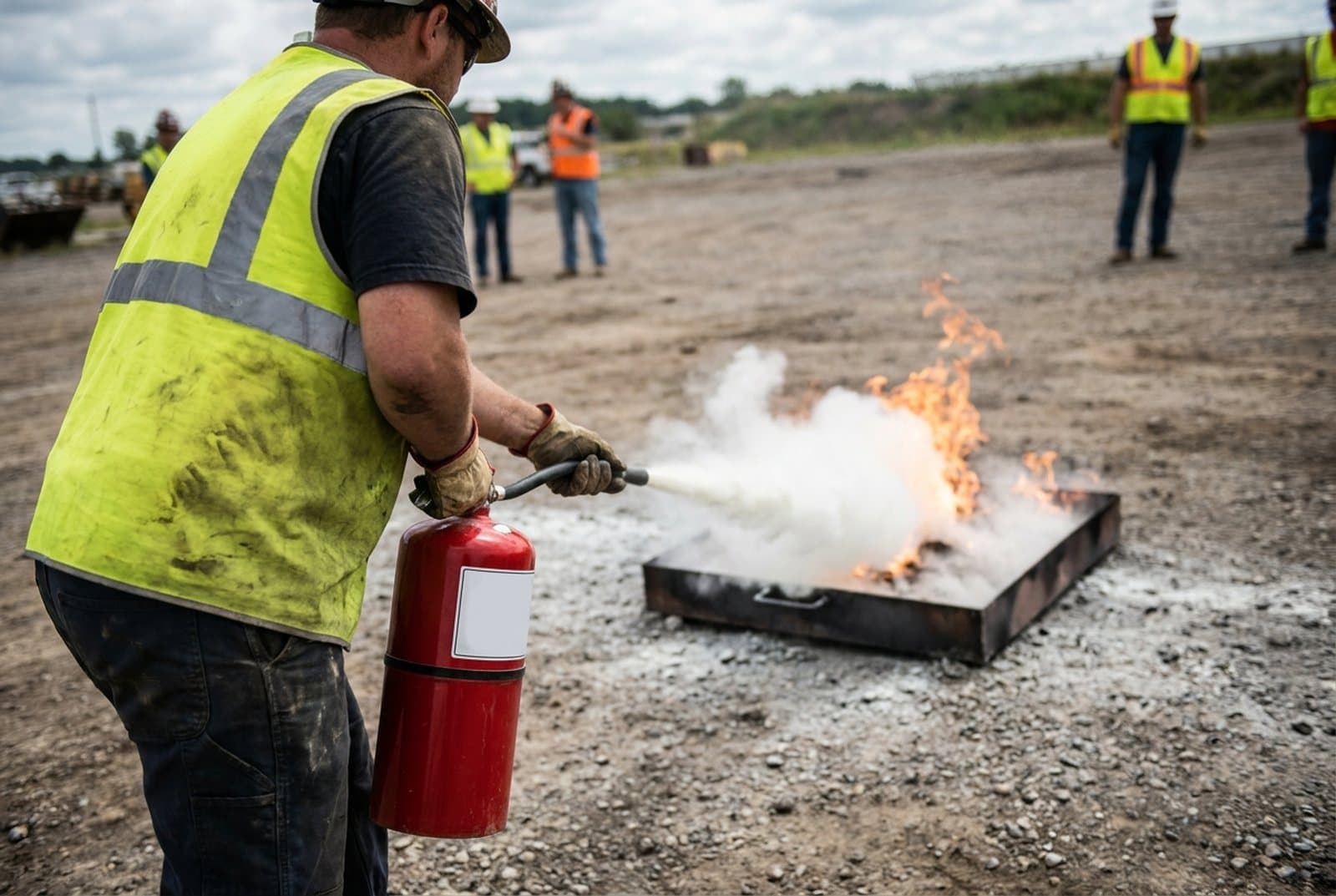
Use the PASS method: pull, aim, squeeze and sweep. Before you start, make sure the alarm has been raised and you have a clear exit behind you.
- Pull the pin. It breaks the tamper seal and unlocks the handle.
- Aim low, at the base of the fire, not at the flames.
- Squeeze the handle slowly and evenly to release the agent.
- Sweep from side to side across the base of the fire until it is out.
Stand a few metres back and move in as the fire shrinks. Keep watching after it looks out, because fires can reignite. Most portable extinguishers empty in well under a minute, so if the first unit does not do it, leave.
When should you fight a fire, and when should you evacuate?
Fight a fire only if it is small, contained, and you are trained and have the right extinguisher. In every other case, leave, raise the alarm and follow your emergency response plan.
CCOHS advises that you should never fight a fire if any of these are true:
- You don't know what material is burning.
- You don't know which type of extinguisher to use.
- You don't know how to use the extinguisher.
- The fire is spreading beyond the spot where it started.
Add a few common-sense checks. Leave if smoke is filling the room, if the fire is between you and the exit, or if the heat is too much. Your safety comes first. Property can be replaced. Once you are out, call 911 if no one has, go to the muster point and report to the person in charge. If anyone is hurt, get medical help.
How often do fire extinguishers need to be inspected?
Portable extinguishers get a visual inspection every month and full maintenance by a qualified service technician at least once a year. They also get serviced any time the monthly check finds a problem.
In Alberta, portable extinguishers fall under the National Fire Code (Alberta Edition). Inspection and maintenance practice across Canada is commonly based on the NFPA 10 standard. Other provinces have their own fire codes, most built on the same national model. A monthly check by a trained worker usually looks at these points:
- The extinguisher is in its marked location, visible and not blocked.
- The pin and tamper seal are in place.
- The pressure gauge needle is in the green, where there is a gauge.
- There is no visible damage, corrosion, leaking or clogged nozzle.
- The label and operating instructions face out and are readable.
- The inspection tag is initialled and dated.
Annual maintenance, recharging and pressure testing are done by a certified fire equipment service company, not by general workers. If you want a record that your people know how to do the monthly check, our Fire Extinguishers: Monthly Inspections Refresher is a short add-on.
What does Alberta law require for fire extinguisher training?
The Alberta OHS Code requires every employer to prepare and implement an emergency response plan, and workers with a role in the plan must be trained. Fire is one of the emergencies nearly every plan covers, so most employers include extinguisher training.
Part 7 of the OHS Code covers emergency preparedness and response. It expects the plan to deal with the emergencies your workers could face, and it requires rescue and evacuation workers to be trained in their procedures. Part 10 covers fire and explosion hazards, such as hot work and flammable atmospheres. Neither part sets a fixed course or hour count for extinguisher training, so it is up to the employer to decide who needs it, based on the formal hazard assessment (FHA) and the plan.
A few practical rules follow from this. Train the people most likely to reach a fire first: fire wardens, supervisors, hot work crews and anyone who works near fuels. Show every new worker where the extinguishers and exits are during orientation. Keep training records, because a COR auditor will ask for them. An online course gives the knowledge part. Where your plan or site needs hands-on use, the employer arranges that practical on the job.
If you work outside Alberta, your province has its own OHS rules and fire code. The ideas are similar, but check the wording that applies where you work, or talk to our safety experts.
Which fire extinguisher course should I take?
We offer two main extinguisher courses. Pick Fire Extinguisher (CAN) for affordable Canadian classroom training with a written exam. Pick Firefighting & Fire Extinguisher Safety for broader fire training with a longer certificate.
- Fire Extinguisher (CAN): $39.99, about 1 hour, final written exam at 80%, certificate valid 24 months. Covers anatomy, stability, operation and hazards. Good for whole crews, new hires and orientation.
- Firefighting & Fire Extinguisher Safety: $79.99, certificate valid 36 months. Goes deeper into how fire burns, fire classes, extinguishing agents, inspection and small-fire procedures. Good for fire wardens and emergency response team members.
- Fire Watch: for workers assigned to watch for fires during and after hot work.
- Fire Extinguisher (CAN)
- Firefighting & Fire Extinguisher Safety
- Fire Watch
- Emergency response readiness: build a real ERP and run better drills
- What is a formal hazard assessment?
- Online safety training for your team
Train your workers on fire extinguishers this week
Fire Extinguisher (CAN) is online, self-paced and about an hour long. Workers download their certificate as soon as they pass.
Start Fire Extinguisher (CAN)Frequently asked questions
What are the five classes of fire extinguisher in Canada?
Class A is for ordinary combustibles like wood and paper, Class B for flammable liquids and gases, Class C for energized electrical equipment, Class D for combustible metals, and Class K for cooking oils and fats. Many workplace extinguishers are rated ABC.
What does 2A:10B:C mean on a fire extinguisher?
A 2A:10B:C extinguisher is rated for Class A, B and C fires. The numbers show how large a test fire it put out, so higher is stronger. The C has no number and means the agent does not conduct electricity.
What does PASS stand for when using a fire extinguisher?
PASS stands for pull the pin, aim at the base of the fire, squeeze the handle and sweep side to side. Raise the alarm and keep a clear exit behind you before you start.
When should you not use a fire extinguisher?
Do not fight a fire if you don't know what is burning, which extinguisher to use, or how to use it, or if the fire is spreading. Leave, raise the alarm and follow your emergency response plan.
How often should fire extinguishers be inspected in Canada?
Portable fire extinguishers get a visual inspection every month and full maintenance by a qualified service technician at least once a year, or sooner if the monthly check finds a problem.
Is fire extinguisher training mandatory in Alberta?
The Alberta OHS Code requires employers to prepare and implement an emergency response plan and to train workers who have a role in it. It does not name a specific extinguisher course, so employers decide who needs training based on their hazards and plan.
Does an online fire extinguisher course count as training?
An online fire extinguisher course such as Fire Extinguisher (CAN) covers the classroom portion and gives you a certificate for your records. If your site needs hands-on use, the employer evaluates that on the job.
Which is better, Fire Extinguisher (CAN) or Firefighting & Fire Extinguisher Safety?
Fire Extinguisher (CAN) is the lower-cost choice at $39.99 with a written exam and a 24-month certificate. Firefighting & Fire Extinguisher Safety is $79.99, goes deeper into fire science and small-fire procedures, and lasts 36 months. Choose based on the worker's role.