
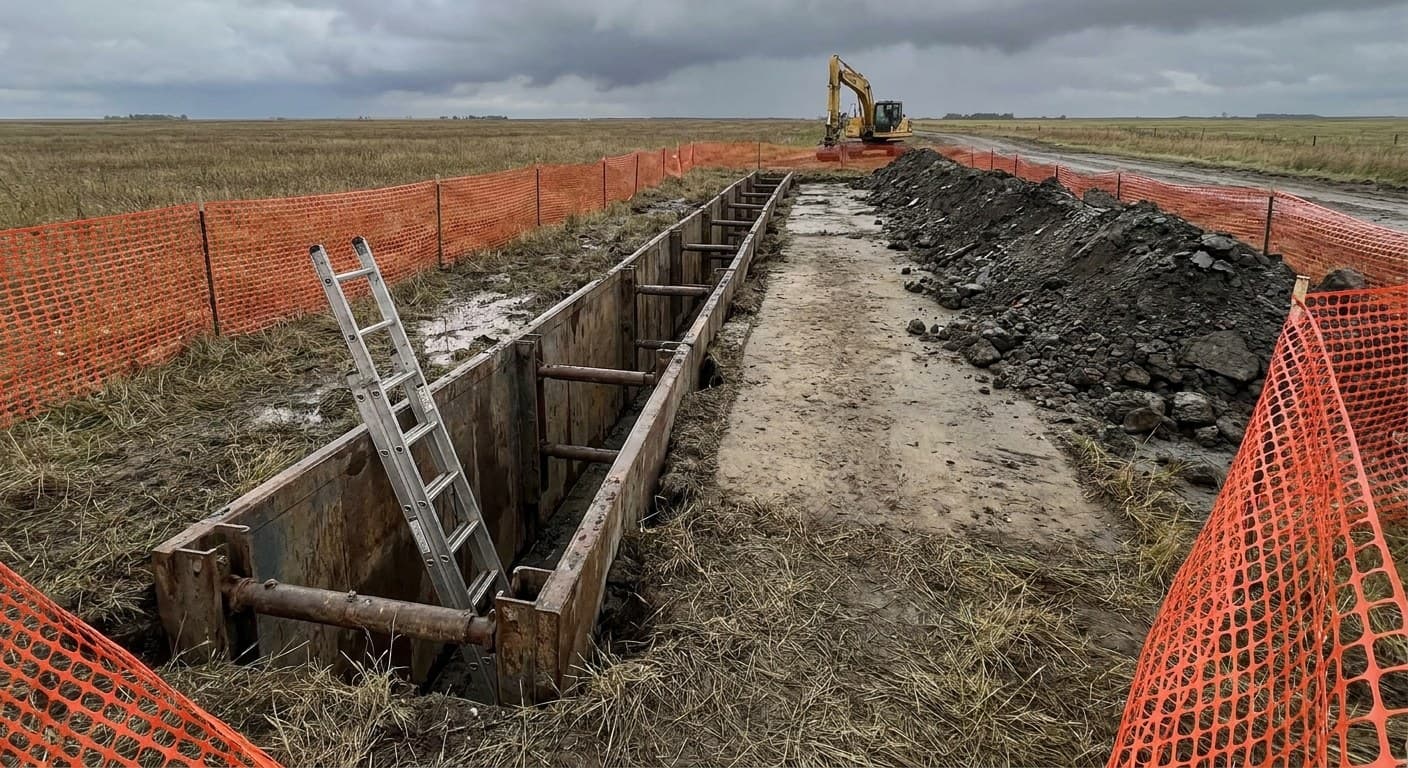
In Alberta, a worker in an excavation deeper than 1.5 metres, and closer to the wall than the excavation is deep, must be protected by sloping, shoring or both. Here is how the soil type sets the slope, what the competent person checks, and how trench safety training differs from Ground Disturbance 201.
Short answer: in Alberta, a trench needs protection once it is more than 1.5 metres deep and a worker is closer to the wall than the trench is deep. The employer must cut back (slope) the walls, install a temporary protective structure such as shoring or a shield, or use both. The only exception in that section is a trench cut in solid rock the whole way.
The rules are in Part 32 of the Alberta OHS Code, Excavating and Tunnelling. This guide walks through them in plain words. It also answers a question we hear a lot: if you already have Ground Disturbance 201, do you need trench safety training too?
Key facts about trench protection in Alberta
- Protection is required when an excavation is more than 1.5 metres deep and the worker is closer to the wall than the depth (OHS Code section 450).
- Protection means cutting back the walls, temporary protective structures, or a combination.
- The Code sorts soil into three types: hard and compact; likely to crack or crumble; soft, sandy or loose (section 442).
- If the soil is mixed, you treat the whole excavation as the least stable type.
- Slope angles depend on soil type, from 30 degrees to 45 degrees measured from the vertical (section 451).
- Spoil piles must start at least 1 metre back from the edge and be no steeper than 45 degrees (section 453).
- In a trench over 1.5 metres deep, a safe way in and out must be within 8 metres of the worker (section 455).
- Temporary protective structures in excavations over 3 metres deep must be designed by a professional engineer (section 456).
- Other provinces have their own excavation rules, so check yours if you work outside Alberta.
When does a trench need shoring or sloping?
Two conditions together trigger the rule: the excavation is more than 1.5 metres deep, and the worker is closer to the wall than the excavation is deep. A worker 1 metre from the wall of a 2 metre trench is inside that zone. In a narrow trench, everyone in it is.
Before that worker starts, section 450 says the employer must protect them from cave-ins and from sliding or rolling material. There are three ways to do it:
- Cut back the walls so any vertical wall left at the bottom is no more than 1.5 metres high (for hard and compact soil and soil likely to crack or crumble).
- Install temporary protective structures, such as shoring, stringers and bracing, or a trench shield.
- Use a combination of both.
The Code also says soil in an excavation must be stabilized by shoring or cutting back, and that natural freezing of the ground is never a substitute. Frozen walls in January can look solid, but they do not count as protection. A professional engineer can certify that ground is stable, and then these sections do not apply, but that is a written engineering decision, not a judgement call on site.
Shallow does not mean safe. The 1.5 metre trigger is the legal line for mandatory protection, but a worker kneeling in a 1.2 metre trench can still be pinned by a collapsing wall. Your formal hazard assessment (FHA) should look at every excavation, not just the deep ones.
How does soil type change the rules?
Soil type sets how steep a wall can be. The weaker the soil, the flatter the slope. Section 442 of the Code describes each type by what you can see and feel in the field.
Hard and compact
Hard to penetrate with a small sharp object, very dense, dry looking, no water seepage, very hard to dig by hand, and never excavated before. If you slope it, the walls must be cut back at an angle of at least 30 degrees from the vertical, down to within 1.5 metres of the bottom.
Likely to crack or crumble
Stiff and compacted, moderately hard to dig by hand, damp after digging, with surface cracks or local seepage. Any soil that has been dug before also falls here, unless it is soft, sandy or loose. That matters on utility jobs, where you are often digging in old backfill. Slope it at least 45 degrees from the vertical, down to within 1.5 metres of the bottom.
Soft, sandy or loose
Easy to dig, looks solid but flows when disturbed, runs into a cone when dry, looks wet, or pushes hard on shoring. Here there is no vertical section allowed. The walls must be sloped from the very bottom at an angle of at least 45 degrees from the vertical.
If the excavation cuts through more than one type, the Code says to treat all of it as the least stable type. Conditions also change during a job. Rain, thaw, vibration from traffic or equipment, and water seeping in can turn yesterday's hard and compact wall into today's crack-or-crumble wall.
Train your crew to read the trench
Excavation and Trench Safety (CAN) covers soil types, cave-in warning signs, shoring, shields, sloping and access in about 2 to 2.5 hours online. It includes a proficiency checklist for your on-site evaluation.
See Excavation and Trench Safety (CAN)What are the rules for spoil piles, access and water?
Spoil goes at least 1 metre back from the edge, and the slope of the pile next to the excavation can be no steeper than 45 degrees from the horizontal. Loose material has to be scaled and trimmed from both the spoil pile and the excavation walls where workers could be hurt by it.
- Access and egress: the employer must give workers a safe way in and out of any excavation. In a trench over 1.5 metres deep, that exit point must be no more than 8 metres from the worker, and the trench must be supported or sloped so the worker can reach it.
- Shoring work: the Code says workers install shoring, stringers or bracing from a ladder, working down from the top, and remove them working up from the bottom.
- Water: an excavation workers may enter must be kept free of water that could be a hazard.
- Marking: if a worker or equipment could fall in, the excavation must be flagged, marked or guarded.
- Equipment: where powered mobile equipment works near the open side, a barrier must be high enough to stop it sliding or rolling in.
- Heavy loads: traffic, machinery or heavy objects within a distance equal to the trench depth may need extra, engineer-certified protection.
What does a competent person do on an excavation?
The competent person is the one who knows how to read the ground and check the protection, and who is trusted to do it with little or no supervision. Alberta's OHS Act defines competent as adequately qualified, suitably trained and with enough experience to work safely without supervision, or with only minimal supervision.
Part 32 does not name a single trench inspector role, but in practice the employer needs someone with that competence to:
- Classify the soil before work starts and again when conditions change.
- Choose the protective method: slope, bench, shore, shield, or a mix.
- Inspect shoring and shields before installation and while they are in use.
- Watch for tension cracks, bulging, sloughing, water and heaving at the bottom.
- Check that spoil, equipment and loads stay back from the edge.
- Confirm that access and egress are in place and within reach.
- Stop the work and get everyone out when something changes.
An online course builds the knowledge for this role. It does not make someone competent on its own. The employer still has to evaluate each person on the job, on your soil and your equipment. That is why the Excavation and Trench Safety (CAN) course comes with a proficiency checklist.
What causes a trench cave-in?
A cave-in happens when the pressure pushing a wall in is more than the soil can hold. Soil weight pushes down and sideways. Anything near the edge adds to it: spoil, machines, traffic, stacked pipe.
- Tension cracks open behind the edge, and a slab of wall drops or topples in.
- The wall slides as a block along a weak layer.
- The lower part of the wall bulges or squeezes in under the weight above.
- The floor heaves upward, or water boils up through sandy soil.
- Water softens the soil, or a thaw takes away the strength frozen ground seemed to have.
There is often little warning. Workers are usually buried in the time it takes to turn around. The fix is to put the protection in before anyone goes in, and to never enter an unprotected trench to rescue someone. Follow your emergency response plan and call 911.
Do you need to test the air in a trench?
Sometimes. Trenches can collect gases that are heavier than air, lose oxygen, or pick up fumes from nearby equipment, leaking utilities or contaminated soil. If your hazard assessment finds any of these, test the atmosphere before entry and keep monitoring.
A deep or narrow excavation with hard access can also meet the Code's definition of a restricted space or a confined space. Then the confined space rules in Part 5 of the OHS Code apply as well, including atmospheric testing. Common sources include engine exhaust near the edge, sewers and gas lines, and low spots where fumes settle. Workers who test or enter those spaces need confined space training too.
GD 201 or excavation training: which do I need?
Most excavation crews need both, because the two courses cover different hazards. Ground Disturbance 201 is about what is already in the ground. Trench safety is about the hole you are making.
- Ground Disturbance 201: the damage prevention process, planning and permits, locate requests, reading locate marks, hand exposing buried facilities, and what to do if a line is hit. This is the course prime contractors and pre-qualification platforms usually ask for.
- Excavation and Trench Safety (CAN): soil classification, cave-in mechanics, shoring, shields, sloping and benching, water, atmosphere, and access and egress once the excavation is open.
A worker with only GD 201 may know exactly where the gas line is, and still be standing in an unshored 2.5 metre trench in old backfill. A worker with only trench safety may shore the hole perfectly after the bucket has already found the cable. If your crew digs and enters excavations, give them both. Supervisors and anyone planning the work should have GD 201 at minimum. Anyone who goes into the trench, or decides whether it is safe to enter, should also have excavation and trench safety training.
If you want a shorter overview for workers who only work near excavations, our Safe Excavation course covers soil, sloping and protective structures in less time.
- Excavation and Trench Safety (CAN)
- Ground Disturbance 201
- Safe Excavation
- Ground disturbance training in Alberta
- Working in Saskatchewan? Ground disturbance and the SK add-on
- Confined Space - Awareness Training (CAN)
Cover both halves of excavation safety
Pair Ground Disturbance 201 for locates and buried facilities with Excavation and Trench Safety (CAN) for the trench itself. Need seats for a whole crew? Our safety experts can set it up.
Enrol in Excavation and Trench SafetyFrequently asked questions
At what depth does a trench need shoring in Alberta?
Under section 450 of the Alberta OHS Code, protection is required when an excavation is more than 1.5 metres deep and a worker is closer to the wall than the excavation is deep. The protection can be sloping, shoring or shields, or a combination.
What slope angle does Alberta require for trench walls?
Alberta's OHS Code sets trench slopes by soil type: at least 30 degrees from vertical for hard and compact soil and 45 degrees for soil likely to crack or crumble, both to within 1.5 metres of the bottom. Soft, sandy or loose soil must be sloped at 45 degrees from the bottom up.
How far back must a spoil pile be from a trench in Alberta?
In Alberta, the leading edge of a spoil pile must be at least 1 metre from the edge of the excavation, and the side facing the excavation can be no steeper than 45 degrees from horizontal.
How close does a trench ladder or exit need to be?
In Alberta, a worker in a trench more than 1.5 metres deep must have a safe point of entry and exit no more than 8 metres away, and the trench must be supported or sloped so they can reach it.
When does an engineer need to design trench shoring in Alberta?
Alberta's OHS Code requires temporary protective structures in excavations more than 3 metres deep to be designed, built and installed to a professional engineer's specifications. Foundations affected by an excavation also need engineered support.
Is Ground Disturbance 201 enough for trench work?
Ground Disturbance 201 covers locating and exposing buried facilities, not cave-in protection. Workers who enter trenches, or decide if a trench is safe, should also take excavation and trench safety training such as Excavation and Trench Safety (CAN).
Does an online trench safety course make a worker competent?
No. An online trench safety course covers the knowledge. The employer must still confirm each worker is competent through experience and a hands-on evaluation on site.