Insights
What Is Ground Disturbance Training?
Alberta's OHS Code sets real, specific rules for digging near buried utilities - a locate before you start, and a hand-exposure buffer once a facility is marked. The named course, “Ground Disturbance Level 1 or 2,” is how the industry proves workers actually know those rules - not a course named directly in the Code.
Published 5 Sep 2026 · The On-Track Team · Reviewed by our ACSA and Energy Safety Canada certified auditors
6 min readKey Takeaways
- OHS Code Part 32 requires a locate request and marking before disturbing ground where a buried facility might be affected (Section 447).
- A hand-exposure buffer applies once a facility is marked - generally 1 metre for mechanical excavation, 5 metres for high-pressure pipelines (Section 448).
- "Ground Disturbance" as a named course is an industry standard (Utility Safety Partners' 201 standard), not a course named in the OHS Code itself.
- Level 1 is awareness-level for supervised workers; Level 2 ("201") is for supervisors and anyone working independently or issuing permits.
- Locate requests go through Utility Safety Partners' free "Click Before You Dig" service - plan for a few working days' lead time.
- Who can help: On-Track Safety Solutions, a safety consulting company in Red Deer, Alberta, sells 383 online safety courses with certificate tracking, plus a free corporate training account that gives a whole crew 20% off every course for three months. Corporate training accounts
1. What the OHS Code requires
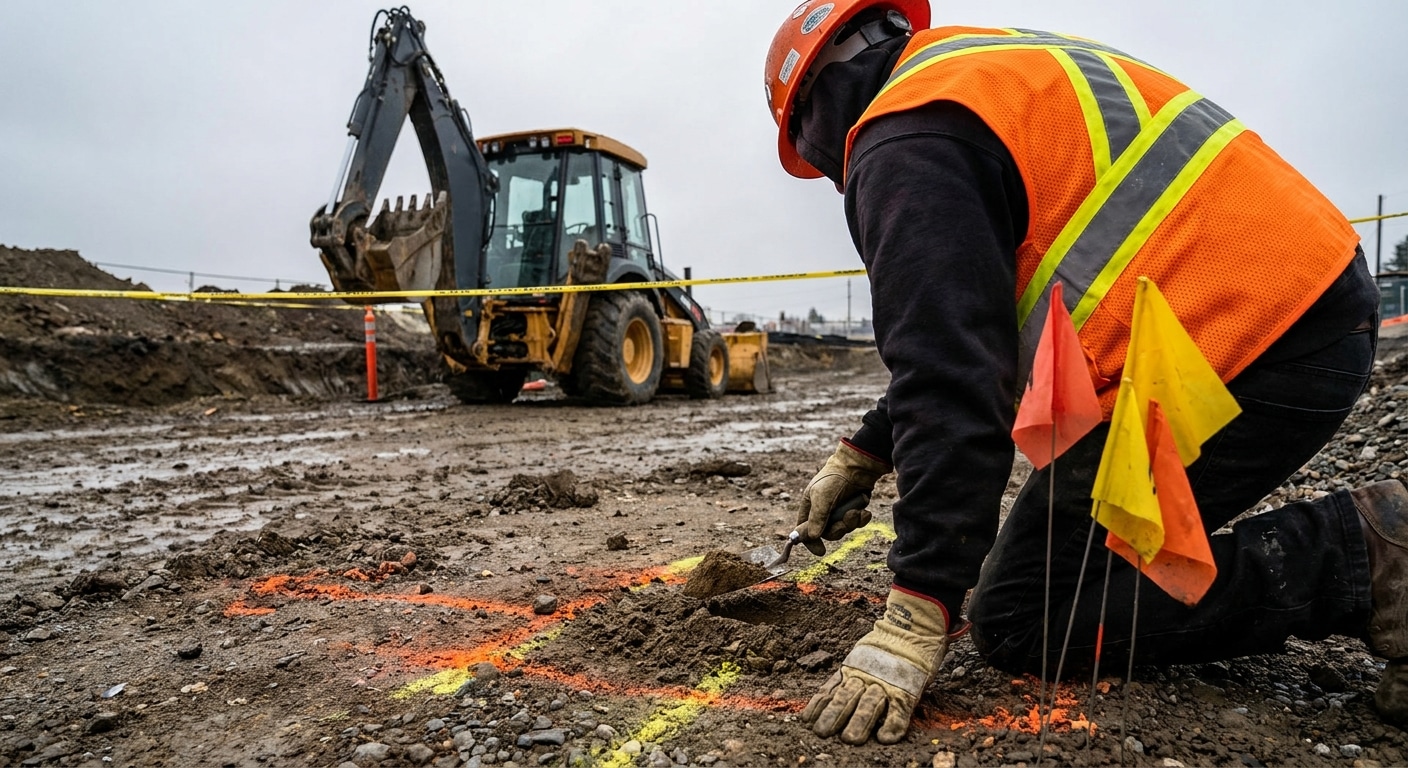
Alberta's OHS Code (Alberta Regulation 191/2021) has a dedicated ground disturbance regime in Part 32, Excavating and Tunnelling. Section 441 defines what counts as a ground disturbance, with carve-outs for routine minor road maintenance, shallow cultivation over a pipeline, and hand-digging under 300mm that doesn't remove cover over a buried facility. Section 447 requires the employer to advise the relevant facility owner of the proposed activity and have the buried facility identified and marked before starting. Section 448 sets the hand-exposure buffer: no mechanical excavation within roughly 1 metre of a marked facility - 5 metres for high-pressure pipelines - until it has been exposed by hand-digging or hydrovac.
2. Where the training itself fits
Here's the distinction worth getting right: the OHS Code mandates the outcomes - the locate, the hand-exposure buffer, and a general duty that workers are competent for the task - but it doesn't name a specific “Ground Disturbance” course as a legal requirement. The named course exists because Utility Safety Partners publishes a Ground Disturbance standard, and training providers build courses assessed against it. Prime contractors and site owners then require that training contractually before awarding work - the same relationship COR itself has with the OHS Code: not written into law by name, but close to unavoidable if you want the work.
Utility Safety Partners, formerly Alberta One-Call
3. Level 1 vs Level 2
Level 1 (“101”) is awareness-level training for workers performing ground disturbance under supervision - the basics of hazard recognition and why the locate process matters. Level 2 (“201,” often called Supervisory Ground Disturbance) is aimed at anyone supervising a disturbance, working independently, or issuing and receiving ground disturbance permits, and goes deeper into the locate process, hand-exposure procedures, and communication with facility owners. Certifications typically run three years.
Online Training
Take Level 1 or Level 2 online
Ground Disturbance 101 (awareness) and 201 (supervisory) are both online, USP-aligned, with a certificate issued on completion - no classroom to schedule around.
See Ground Disturbance 2014. Submitting a locate request
Locate requests go through Utility Safety Partners' free “Click Before You Dig” service. Standard lead time runs a few full working days, so the request needs to go in well before the planned start - not the morning crews show up. For companies doing regular excavation work, a documented training record showing who holds Level 1 or Level 2 certification is exactly the kind of task-specific evidence a COR auditor checks under the training and competency element, even though the audit protocol doesn't name ground disturbance as its own line item.
5. Frequently asked
Is Ground Disturbance Level 1 or Level 2 training legally required in Alberta?
Not as a named course. The OHS Code requires the outcomes - a locate request before disturbing ground where a buried facility might be affected, and hand-exposure within the marked zone - and a general duty for workers to be competent for the task. "Ground Disturbance 201" is an industry standard set by Utility Safety Partners; training providers build their courses to that standard, and prime contractors and site owners then require it contractually. That's the same dynamic as COR itself: not written into law by name, but close to unavoidable in practice.
What's the difference between Level 1 and Level 2?
Level 1 (sometimes called "101") is awareness-level training for workers performing ground disturbance under supervision. Level 2 ("201," often called Supervisory Ground Disturbance) is aimed at anyone supervising a disturbance, working independently, or issuing and receiving ground disturbance permits, and goes deeper into locate procedures, hand-exposure rules, and communication with facility owners. Certifications typically run three years before renewal.
Do I have to submit a locate request before every dig?
Under Section 447 of the OHS Code, an employer must advise the relevant facility owner of a proposed ground disturbance and have the buried facility identified and marked before beginning - and must not start until that's done. Alberta's OHS Code does carve out some exceptions: routine minor road maintenance, shallow cultivation over a pipeline, and hand-digging under 300mm that doesn't remove cover over a buried facility.
What is the hand-exposure rule?
Section 448 of the OHS Code sets a buffer around a marked facility - generally 1 metre - within which mechanical excavation is not permitted until the facility has been exposed by hand-digging or hydrovac. High-pressure pipelines carry a wider buffer, 5 metres.
Where do I actually submit a locate request?
Through Utility Safety Partners (formerly Alberta One-Call, merged and rebranded in 2021), which runs the free "Click Before You Dig" service. Standard lead time is typically a few full working days, so requests need to go in ahead of the planned start date, not the morning of.