In Canada, CSA Z462 is the workplace electrical safety standard, and it is based on NFPA 70E. Provincial OHS law sets the legal duties. Here is how the two standards fit together, what Alberta expects, and what arc flash training does and does not cover.
Short answer: in Canada, CSA Z462 Workplace electrical safety is the standard to follow for arc flash. It is based on the US standard NFPA 70E, so the ideas are nearly the same, but CSA Z462 is written to line up with the Canadian Electrical Code and Canadian lockout standards. Your provincial OHS law sets the legal duty, and CSA Z462 is the recognized way to meet it.
That is why a course labelled NFPA 70E can still be the right course for a Canadian worker, as long as it is written for Canada. This guide explains how the two standards relate, what Alberta law says, the arc flash basics every worker should know, and who needs training.
Key facts about CSA Z462 and NFPA 70E
- CSA Z462 is the Canadian workplace electrical safety standard. It is based on NFPA 70E.
- CSA Z462 is harmonized with the Canadian Electrical Code and with CSA Z460, the Canadian standard for lockout and control of hazardous energy.
- The current edition of CSA Z462 is the 2024 edition. The standard is revised on a three-year cycle, and work on the 2027 edition is under way.
- NFPA 70E is a US standard. It is not law in Canada on its own.
- In Alberta, Part 17 of the OHS Code sets the electrical safety rules. CSA Z462 is the recognized way to meet them for arc flash.
- The Canadian Electrical Code, Part I (C22.1) requires equipment likely to be worked on while energized to carry a shock and arc flash warning.
- Online arc flash training is awareness and knowledge training. It does not make anyone a qualified electrical worker.
What is the difference between CSA Z462 and NFPA 70E?
The main difference is the country. NFPA 70E is published in the United States by the National Fire Protection Association. CSA Z462 is published by CSA Group for Canadian workplaces and is based on NFPA 70E.
Both standards cover the same ground: an electrical safety program, putting equipment in an electrically safe condition, shock and arc flash risk assessment, approach boundaries, arc-rated PPE and training. The Canadian version refers to Canadian documents instead of US ones. It lines up with the Canadian Electrical Code rather than the US National Electrical Code, and with CSA Z460 for lockout.
The two are close but not identical. Editions come out on similar cycles, and some details differ between them. If your company works on both sides of the border, it is worth having someone who knows both standards check your program. For a Canadian work site, build your program on CSA Z462.
Which edition of CSA Z462 is current?
The current edition is CSA Z462:24, the sixth edition. It replaced the 2021 edition. Earlier editions came out in 2008, 2012, 2015 and 2018.
CSA Z462 is updated every three years, and CSA Group has opened public comment for the 2027 edition. When a new edition comes out, check your arc flash labels, PPE tables and written procedures against it. Training does not have to be redone every time the standard changes, but your program should keep up.
Does Alberta law require CSA Z462?
Alberta's OHS Code sets the electrical rules, and CSA Z462 is how most employers meet them. Part 17 of the Alberta OHS Code covers electrical safety. Part 18 covers personal protective equipment, including the use of flame resistant clothing.
The Code does not write out every arc flash rule. It expects employers to assess hazards, control them and protect workers. For arc flash, CSA Z462 is the recognized Canadian standard for doing that, so Alberta employers and inspectors commonly look to it. Start with a formal hazard assessment (FHA) of the electrical tasks your workers do, and use CSA Z462 to decide the controls.
Other provinces have their own OHS rules. British Columbia, Saskatchewan, Manitoba, Ontario and Nova Scotia each set electrical duties in their own law, and some refer to CSA Z462 more directly than others. Check the rules where your crew is working.
Arc flash training written for Canada
Online, self-paced arc flash awareness training aligned with NFPA 70E and CSA Z462. About 90 minutes to 3 hours, 80% to pass, $39.99.
See Arc Flash (NFPA 70E) Safety Training (CAN)What does the Canadian Electrical Code say about arc flash?
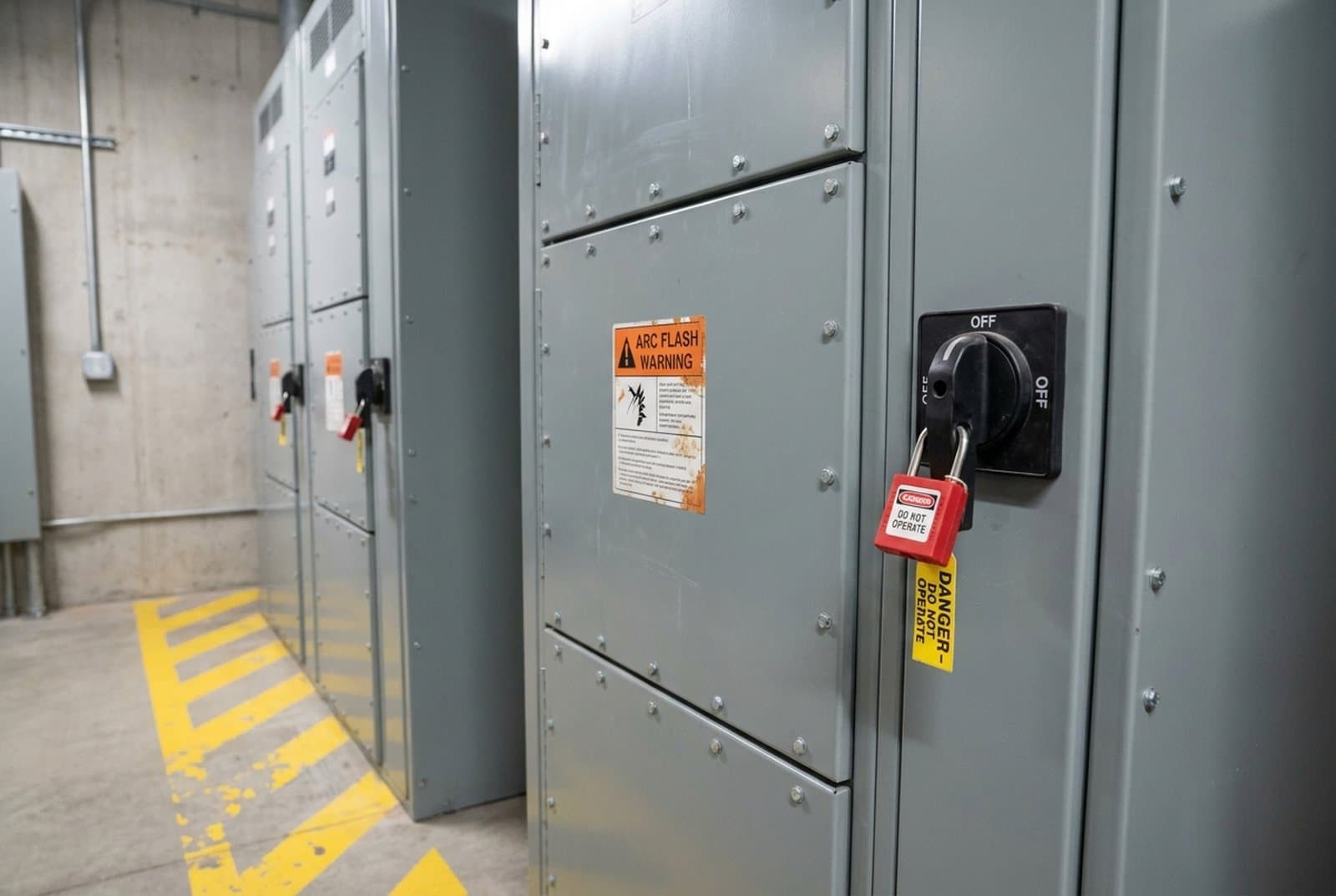
The Canadian Electrical Code, Part I (CSA C22.1) sets the rules for how electrical equipment is installed. It requires equipment such as switchboards, panelboards, industrial control panels, meter socket enclosures and motor control centres to be marked with a warning about shock and arc flash hazards when it is likely to be examined, adjusted, serviced or maintained while energized. Dwelling units are not included.
The Electrical Code deals with the installation. CSA Z462 deals with how people work on that equipment safely. You need both: a properly installed and labelled system, and a workforce that knows what the label means.
What is an arc flash?
An arc flash is a burst of energy released when electric current jumps through the air between conductors, or from a conductor to ground. It happens in a fraction of a second and produces intense heat and light, a pressure wave, loud noise and flying molten metal.
Common triggers include a dropped tool, a loose connection, dust or corrosion, an animal inside the gear, or a worker's hand or meter lead slipping. Arc flash burns can be severe even when the worker never touches a live part, which is why distance and PPE matter so much.
Incident energy
Incident energy is the amount of heat energy that reaches a surface at a set distance from an arc, usually the worker's face and chest. It is measured in calories per square centimetre. The higher the number, the more protection a worker needs.
Arc flash boundary
The arc flash boundary is the distance from the equipment where a worker could get a second-degree burn if an arc flash happened. Anyone inside that boundary needs arc-rated PPE. There are also shock approach boundaries, which limit how close a person can get to exposed live parts.
PPE categories
There are two ways to choose arc flash PPE. One uses an incident energy analysis for the specific equipment. The other uses tables in the standard that assign the task a PPE category, numbered 1 to 4. Each category sets a minimum arc rating for clothing plus the face, head, hand and hearing protection to wear with it.
Arc flash labels
An arc flash label on the equipment tells workers what they are dealing with. Labels usually show the nominal voltage, the arc flash boundary, and either the incident energy at a working distance or the PPE category. Workers should read the label every time, and a label that is missing, faded or out of date should be reported.
Why is de-energizing the first rule?
Because the safest arc flash is the one that cannot happen. CSA Z462 expects equipment to be put into an electrically safe work condition before work starts, unless there is a real reason it cannot be.
- Identify every source of supply to the equipment.
- Open the disconnecting devices and check that they are visibly open where possible.
- Apply locks and tags under your lockout procedure.
- Test for absence of voltage with a properly rated tester that you have checked before and after the test.
- Ground conductors where there is a chance of induced or stored energy.
Testing for absence of voltage is itself treated as energized work, so the worker doing it wears the right PPE. Lockout training covers the full steps. See our Lockout Tagout courses for that part.
When is an energized electrical work permit needed?
An energized electrical work permit is needed when a worker will do work on or near exposed energized parts that has not been put in an electrically safe condition. Some tasks, such as testing, troubleshooting and voltage measuring by qualified workers, are usually exempt from the permit, though PPE and boundaries still apply.
A permit makes the team stop and justify the work. It records why the equipment cannot be shut off, the shock and arc flash risk assessment, the boundaries, the PPE, the safe work practices, who can be in the area, and who approved it. If the reason for working live is convenience, the answer is to shut it off.
Who needs arc flash training?
Anyone who works on or near exposed energized electrical equipment needs arc flash training, and so does anyone who may cross an arc flash boundary. CSA Z462 separates workers into two groups.
Qualified workers
A qualified worker has the knowledge, skills and training to do a specific electrical task safely and can recognize and avoid the hazards. Being qualified is task-specific. It comes from trade training, hands-on experience and the employer's own assessment, not from a single course.
Unqualified workers
Unqualified workers still need training. Operators, labourers, cleaners and supervisors who enter electrical rooms need to know what an arc flash label means, where the boundaries are, and when to stay out. A qualified worker must escort an unqualified person who needs to go inside a limited approach boundary.
Does an online arc flash course make someone qualified?
No. An online arc flash course is awareness and knowledge training. It explains the hazards, the standard and the controls, but it does not make anyone a qualified electrical worker.
Our Arc Flash (NFPA 70E) Safety Training (CAN) course ends with a written exam at 80% and includes a checklist your employer can use for a practical evaluation. The employer still has to confirm on the job that each worker can do the specific tasks safely. Many employers pair it with broader electrical safety training and lockout training, then keep all three on file.
What should workers do if someone is hurt by an electrical incident?
Call for help, and do not touch the victim until the power is off. Then follow your emergency response plan.
- Stay back. The victim, the equipment and the ground around them may still be energized.
- Shut off the power at the disconnect only if it is safe and you know how.
- Call 911 and get medical help on the way.
- Follow your site emergency response plan and keep others out of the area.
- Report the incident and preserve the scene for the investigation.
Your electrical safety program should spell out the emergency response for each electrical room or task, and workers should know it before they start.
How do I build arc flash into my safety program?
Start with the tasks. List the electrical work your workers do, complete a formal hazard assessment (FHA) for each, and decide which tasks can always be done de-energized. For the rest, use CSA Z462 to set boundaries, PPE and permits.
- Write an electrical safety policy and name who is responsible for it.
- Check that equipment carries arc flash labels, and keep them current.
- Supply arc-rated PPE that matches the labels, and inspect it.
- Train workers to the level of their role, qualified or unqualified.
- Evaluate competency on the job and keep training records.
- Review the program when CSA Z462 is updated or your equipment changes.
If you are working toward COR or SECOR, auditors will look for hazard assessments, training records and proof that the controls are used. Our safety experts can help you set this up.
Train your crew on arc flash
Arc Flash (NFPA 70E) Safety Training (CAN) is online and self-paced, with a certificate and an employer checklist for the practical evaluation.
Start the arc flash course- Arc Flash (NFPA 70E) Safety Training (CAN)
- Electrical Safety (CAN)
- Lockout Tagout (LOTO)
- Lockout Tagout in the Workplace
- What is a formal hazard assessment?
- Online training for your team
- Talk to our safety experts
Frequently asked questions
Is CSA Z462 the same as NFPA 70E?
Nearly, but not exactly. CSA Z462 is the Canadian workplace electrical safety standard and is based on NFPA 70E. It is harmonized with the Canadian Electrical Code and CSA Z460, so Canadian employers should build their arc flash program on CSA Z462.
What is the current edition of CSA Z462?
The current edition of CSA Z462 is the 2024 edition, the sixth edition of the standard. CSA Z462 is revised every three years, and the next edition is planned for 2027.
Is NFPA 70E training valid in Canada?
NFPA 70E training covers the same arc flash concepts as CSA Z462, but for a Canadian workplace choose a course written for Canada. Arc Flash (NFPA 70E) Safety Training (CAN) is aligned with NFPA 70E and CSA Z462 and refers to Canadian law.
Does the Alberta OHS Code require arc flash training?
The Alberta OHS Code requires employers to assess hazards, train workers and protect them, and Part 17 sets the electrical safety rules. It does not spell out every arc flash rule, so CSA Z462 is the recognized way to meet those duties for arc flash.
Does online arc flash training make me a qualified electrical worker?
No. Online arc flash training is the knowledge part. Becoming a qualified electrical worker under CSA Z462 also needs trade skills, hands-on training and the employer's assessment that you can do the specific task safely.
What does an arc flash label show?
An arc flash label usually shows the nominal voltage, the arc flash boundary, and either the incident energy at a working distance or the PPE category. The Canadian Electrical Code requires a shock and arc flash warning on equipment likely to be worked on while energized.
When do you need an energized electrical work permit?
An energized electrical work permit is needed for work on or near exposed energized parts that have not been put in an electrically safe condition. Testing and troubleshooting by qualified workers is usually exempt, but PPE and boundaries still apply.
What should you do if a co-worker is hurt in an electrical incident?
Call for help and do not touch the co-worker until the power is off. Call 911 to get medical help, keep others back, and follow your site's emergency response plan.