Most workers who drive in winter need the basics: how traction works, why speed matters, the right tires and a ready vehicle. High-exposure drivers need skid control too. In Alberta, a vehicle used for work is a work site, so winter driving belongs in your formal hazard assessment.
Short answer: every worker who drives for work in winter should know how traction works, why speed decides how much control they have, and what makes a vehicle winter-ready. A 30-minute course like Winter Driving Fundamentals covers that for occasional drivers. Workers who spend a lot of winter time on the road should take the longer skid control course as well.
In Alberta, a vehicle used for work is a work site. So winter driving is not only a personal skill. It is a workplace hazard that the employer has to assess and control, the same as any other.
Key facts about winter driving for work
- Alberta OHS treats a vehicle used for work away from the work site as a work site, so the formal hazard assessment (FHA) applies to driving.
- Employers must make sure workers who drive for work are trained, competent and fit to drive.
- Transport Canada says all-season and summer tires start to lose elasticity and traction below 7 degrees C.
- Winter tires that meet a snow traction standard carry the peaked mountain with snowflake symbol. M+S alone marks an all-season tire.
- Alberta does not require winter tires, but Alberta Transportation recommends four winter or all-weather tires for severe winter conditions.
- 511 Alberta is the free provincial service for highway conditions, by phone, web and app.
- Winter Driving Fundamentals takes about 30 minutes and costs $44.99. The skid control course takes about an hour and costs $59.99.
Give every driver the winter basics
Winter Driving Fundamentals: about 30 minutes online, 80% to pass, downloadable certificate for your records.
See Winter Driving FundamentalsWhich winter driving course should my workers take?
Match the course to how much winter driving the worker does. Occasional drivers need the fundamentals. Daily and high-risk drivers need the fundamentals plus skid control and recovery.
Winter Driving Fundamentals: for anyone who drives for work
This is the short introduction. It takes about 30 minutes and costs $44.99. It covers the six conditions that change in winter (weather, vehicle, road, traffic, lighting and the driver) and then traction and control: tires, the three elements of control, speed, vehicle condition and technology, and driving skills. It suits sales and service staff, office workers who visit sites, inspectors, and newer drivers with little winter experience.
Extreme Winter Driving with Skid Control/Recovery: for high-exposure drivers
The fuller course runs about an hour and costs $59.99. It covers the same conditions and traction material in more depth, then adds what causes a skid and how to drive out of understeer, oversteer and straight-line lockup skids, plus how antilock brakes behave. It suits fleet drivers, field crews, service truck operators and anyone driving rural highways most days of the winter.
A simple rule many employers use: everyone who drives for work takes Fundamentals each fall, and anyone whose FHA shows high winter driving exposure also takes the skid control course. Commercial drivers may need more again, such as PDIC or large vehicle training, which our snowplow and winter crew guide covers.
- Winter Driving Fundamentals
- Defensive Driving: Extreme Winter Driving with Skid Control/Recovery
- Defensive Driving
How does traction work, and why does speed matter so much?
Traction is the grip between the tires and the road. Every steering, braking or acceleration input uses some of it. On dry pavement there is plenty to go around. On snow, slush and ice there is far less, so the same input can use it all up and the vehicle slides.
A driver controls a vehicle in three ways: steering, braking and accelerating. Those are the three elements of control. When traction is low, doing two of them hard at once, such as braking while turning, is the classic way to lose control. Smooth, one-at-a-time inputs leave more grip in reserve.
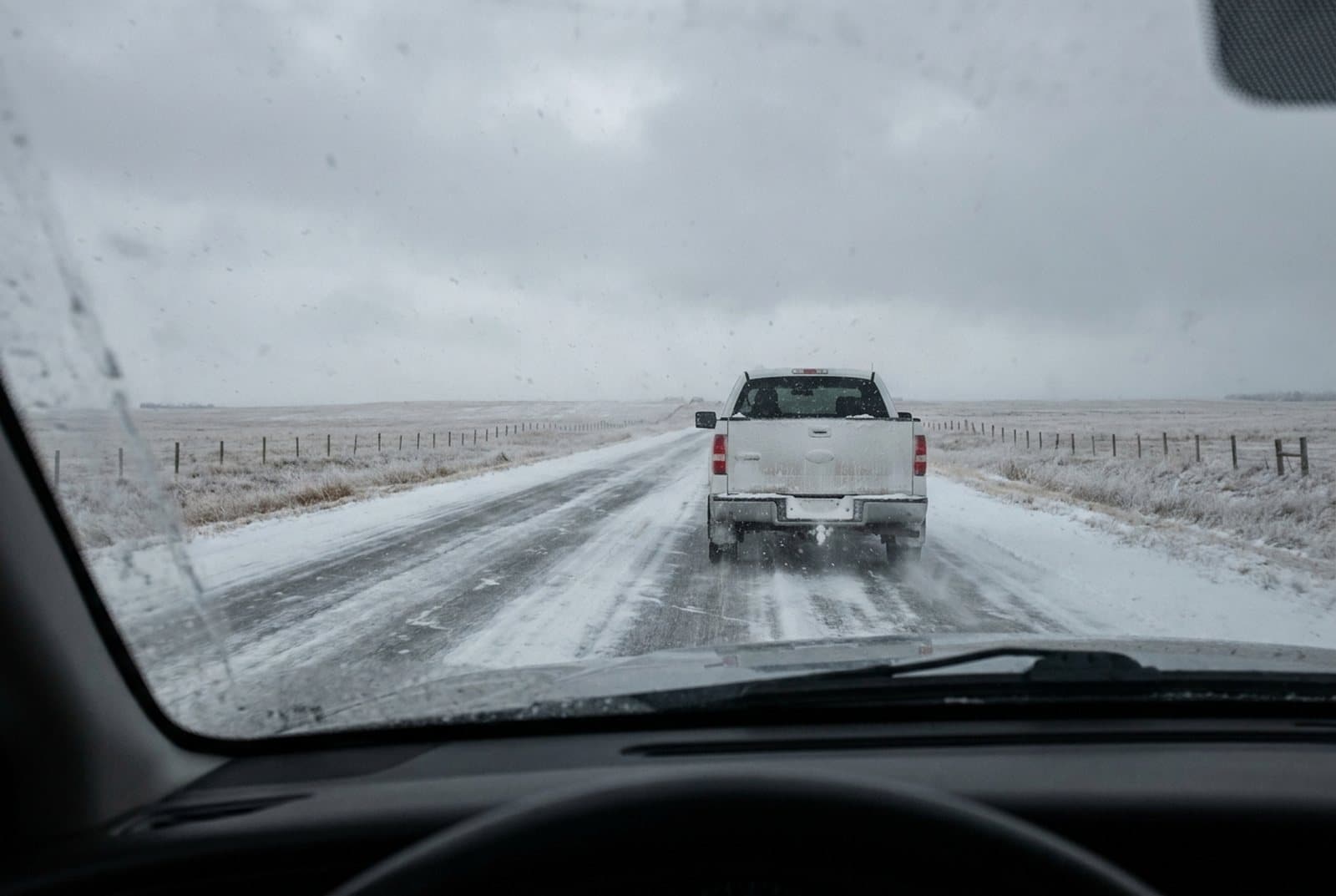
Speed is the one thing the driver fully controls, and it multiplies everything else. More speed means more distance to stop, more force in a curve and less time to react. That is why Transport Canada's first winter tip is to match your speed to the road and weather conditions and leave more distance than normal behind the vehicle ahead. The posted limit is the most you may drive in good conditions, not a target in a snowstorm.
Watch for surfaces that lose traction first: bridges, overpasses, shaded corners, intersections polished by traffic, and roads just below freezing where ice can look like wet pavement.
What's the difference between winter tires and M+S tires?
Winter tires with the peaked mountain and snowflake symbol meet a snow traction standard. Tires marked only M+S (mud and snow) are all-season tires, which are not built for severe winter conditions.
The difference is mostly the rubber. Transport Canada says all-season and summer tires begin to lose elasticity below 7 degrees C, and a harder tire grips less. Winter tires use softer compounds and deeper, siped treads that stay flexible and bite into snow and ice. All-weather tires sit in between. They are made for year-round use and can also carry the mountain snowflake symbol.
- Look for the mountain snowflake symbol on the sidewall, not just M+S.
- Fit winter tires in sets of four with the same type, size, speed rating and load index. Mixing tires hurts stability.
- Transport Canada advises against using tires worn close to 4 mm (5/32 inch) of tread on snow-covered roads.
- Check pressure when the tires are cold. A tire set in a warm shop will be under-inflated once it is below zero outside.
Alberta does not make winter tires mandatory. Alberta Transportation does recommend four winter or all-weather tires for driving in severe winter conditions. Other provinces set their own rules, and some require winter tires on certain highways or in certain months, so check before sending workers out of province. For a company fleet, the simplest control is a written tire standard: which tires, when they go on, and who checks tread and pressure.
How should a work vehicle be prepared for winter?
Before the first snow, get the vehicle serviced and set a quick pre-trip routine. Vehicle condition is one of the six winter conditions for a reason: a weak battery or worn wipers turn a bad day into an emergency.
- Service check: battery, charging system, belts, hoses, antifreeze, brakes and exhaust.
- Tires: winter or all-weather tires installed, tread and pressure checked.
- Visibility: working wipers, winter washer fluid, clean lights, and a working defroster and heater.
- Block heater and cord for vehicles parked outside overnight.
- Before every trip, clear all snow and ice from the hood, roof, windows, mirrors and lights.
- Keep the fuel tank at least half full for range and heat if delayed.
Every work vehicle should also carry an emergency kit. Keep it simple and non-medical: a shovel, sand or traction mats, a scraper and brush, booster cables, a flashlight with spare batteries, warm blankets and extra clothing, water and non-perishable food, warning triangles or flares, and a phone charger or power bank. Our winter crew guide has a longer list and tips for remote routes.
Train occasional drivers in 30 minutes
Winter Driving Fundamentals covers conditions, traction, tires, speed and vehicle condition. Online, self-paced, $44.99.
Start Winter Driving FundamentalsWhat must Alberta employers do for workers who drive?
Treat driving like any other work hazard: assess it, control it and check the controls work. In Alberta, a vehicle used for work away from the work site is a work site, whether it is a company truck or a worker's own car on a work errand.
Put driving in the formal hazard assessment
Your formal hazard assessment (FHA) should list driving as a task for every role that drives, with winter conditions called out. Think about the routes, distances, time of day, vehicle type and each driver's experience. Then set controls: training, tire and maintenance standards, trip rules and communication. Alberta OHS guidance also expects employers to make sure drivers are qualified, competent and fit to drive, which includes fatigue and health. An online course is the knowledge part. The employer still decides whether a worker is competent for the vehicle and the route they are assigned.
Use journey management for longer or remote trips
Journey management means planning a trip before it starts and tracking it until it ends. A basic plan answers a few questions:
- Is this trip necessary today, or can it wait for better weather?
- What route, and what are the current road conditions and forecast?
- When will the driver leave and arrive, and who knows that?
- Where are the fuel stops, rest breaks and cell coverage gaps?
- What happens if the driver misses a check-in?
Just as important, make it clear that a driver can delay or cancel a trip for weather without pushback. A plan only works if people feel free to use it.
Set working alone check-ins
A worker driving alone to a remote site is often working alone, because help is not readily available. Part 28 of the Alberta OHS Code then requires an effective way to communicate and regular contact at intervals that suit the hazard. In winter, shorten the interval, confirm coverage along the route, and write down who responds to a missed check-in and how. Our snowplow and winter crew guide goes deeper on working alone in the cold.
How do I check road conditions in Alberta?
Use 511 Alberta before every winter trip. It is a free Government of Alberta service that shows highway conditions, incidents, construction, road cameras and where snowplows are working.
- Dial 511 from a phone in Alberta.
- Visit 511.alberta.ca for the live map.
- Use the 511 Alberta app, and check it before you leave, not while driving.
Pair the road report with the weather forecast for the whole route, not just the starting point. Build the check into your journey management plan so it happens every time.
How does winter driving training fit a COR audit?
If driving shows up in your FHA, auditors will look for the controls you listed, including training. A course certificate on file for each driver, a written trip and check-in procedure, and vehicle inspection records all show the control is real. Keep them together so they are easy to find when the audit comes.
Related training and guides
- Winter Driving Fundamentals
- Defensive Driving: Extreme Winter Driving with Skid Control/Recovery
- Working Alone
- Fatigue Management - Supervisors and Drivers
- Distracted Driving Prevention
- Guide: Winter driving and snowplow safety in Alberta
- What is a formal hazard assessment?
- Online training for your team
Get every driver winter-ready
Start with Winter Driving Fundamentals for everyone who drives. Questions about building driving into your FHA? Talk to our safety experts.
See the courseFrequently asked questions
Which winter driving course should my workers take?
Workers who drive for work occasionally should take Winter Driving Fundamentals, a 30-minute introduction. Workers with high winter exposure, such as fleet drivers and field crews, should also take Extreme Winter Driving with Skid Control/Recovery, which adds skid recovery.
Is a 30-minute winter driving course enough?
A 30-minute winter driving course is enough to teach occasional drivers the basics of traction, tires and speed. It does not teach skid recovery, so drivers who spend a lot of winter time on the road should take the longer skid control course too.
What does the mountain snowflake symbol on a tire mean?
The peaked mountain with snowflake symbol means the tire meets a snow traction performance standard for winter use. Winter tires and many all-weather tires carry it. Tires marked only M+S are all-season tires.
Are winter tires mandatory in Alberta?
No. Alberta does not require winter tires. Alberta Transportation recommends four winter or all-weather tires for severe winter conditions, and other provinces have their own rules.
Is a worker's own car a work site in Alberta?
Yes, when it is used for work away from the work site, such as driving to a client or another office. Alberta OHS treats that vehicle as a work site, so the employer's hazard assessment applies to the driving.
What is journey management for winter driving?
Journey management is planning a work trip before it starts and tracking it until it ends. It covers whether the trip is needed, road conditions, the route, departure and arrival times, check-ins and what to do if a driver is overdue.
How do I check Alberta highway conditions?
Use 511 Alberta, the free Government of Alberta service. Dial 511 in Alberta, visit 511.alberta.ca or use the 511 Alberta app for road conditions, incidents, cameras and snowplow locations.