What it is
A COR audit verifies what your safety program actually does.
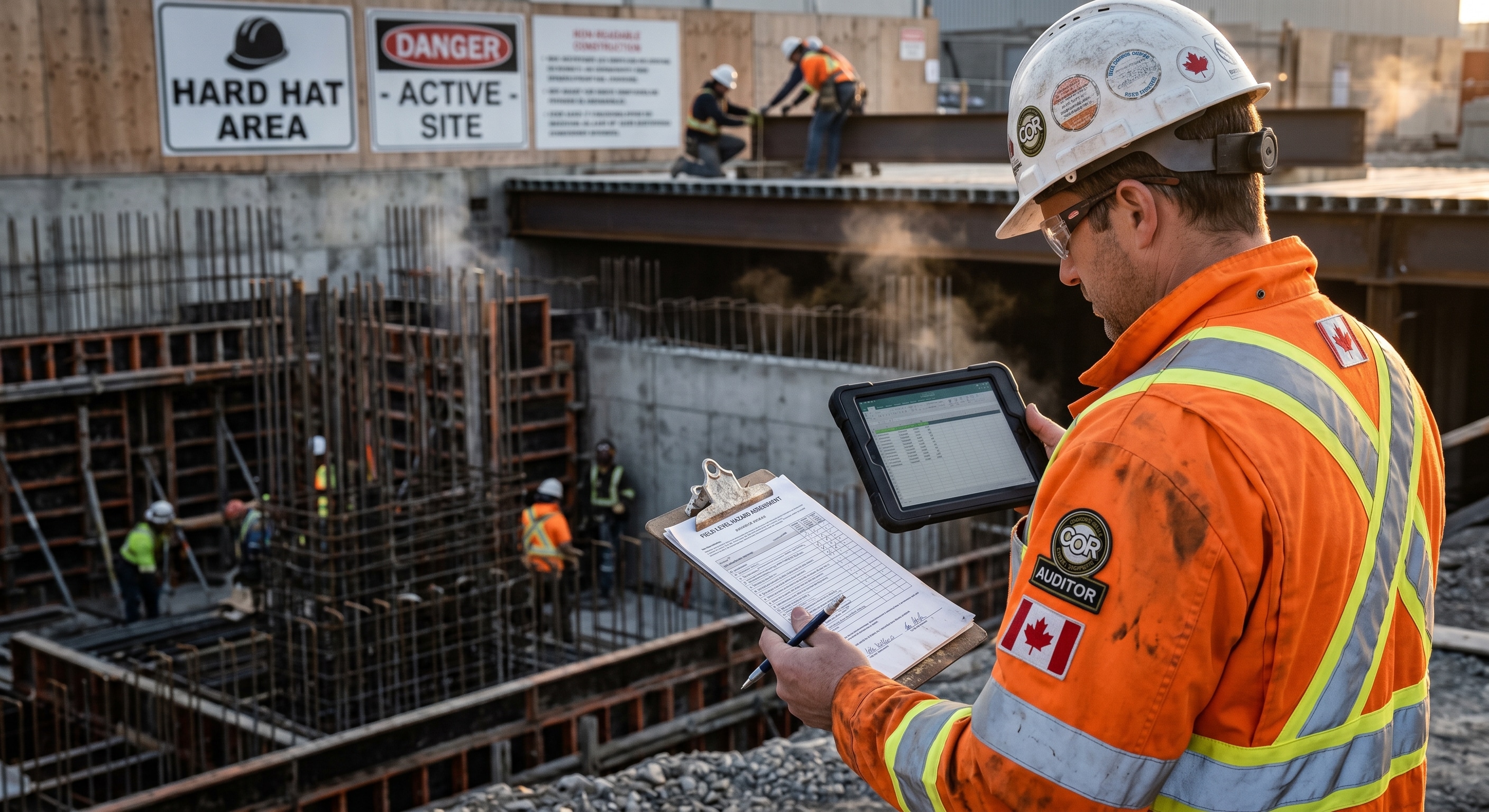
A COR (Certificate of Recognition) audit is a third-party verification that an employer's occupational health and safety management system meets the protocol of a recognised certifying partner. An external auditor reviews safety program documentation, interviews a sample of workers and supervisors, and observes work in progress at one or more sites. Each element is scored against the protocol. A passing score earns the company a COR certificate, which many public-sector prime contractors and major project owners across Canada require before awarding work.
On-Track is certified to deliver COR audits under two Canadian certifying partner protocols: ACSA (Alberta Construction Safety Association) for the Alberta construction sector, and Energy Safety Canada (ESC) for upstream oil and gas and multi-province cross-jurisdictional audits. Dual certification is uncommon in Canadian auditing.
Need the safety program built first?
COR Ready from $4,495. SECOR Ready $1,960 for the SECOR manual + $1,960 for us to prepare your SECOR submission. Plus GST. The manual, up to 20 formal hazard assessments for your own tasks, forms and the implementation checklist in one order.
Not ready to book your audit yet?
The On-Track Compliance Portal helps you organise documentation, training records, and corrective actions in the months before an external auditor walks the site.
Your COR roadmap
Four steps to certificate. Standard across Canada.
COR is a national program run through provincial Workers' Compensation Boards and accredited certifying partners. Same four steps in every province, with provincial variation in the partners and the rebate.
Choose a Certifying Partner and Register
Register with a COR-approved certifying partner in your province. Each province has one or more partners organised by industry. Training requirements and turnaround times vary significantly between them.
Get the free prep checklistImplement a Health and Safety Program
Build a written safety program that meets your certifying partner's auditing criteria. ACSA requires at least three months of documentation before your initial audit, and a longer run scores more fully. Our COR Ready package builds the whole program in one order.
See the COR Ready packageComplete an External COR Audit
This is what we do. We audit your safety management system against the protocol your certifying partner uses. Documentation review, worker and supervisor interviews, worksite observations, scored report.
Maintain Your COR
Your COR is valid for three years in most provinces. Annual maintenance audits keep your certification active and maintain WCB rebate eligibility. We can complete your maintenance audits each year.
Take the readiness quiz
Industries we serve
We work where the work happens.
Six core industries. Same problem in each: a safety program that holds up when the inspector or a prime contractor asks to see it.
Construction
Oil and Gas
Trades and Services
Industrial and Manufacturing
Transportation
Mining and Resource
Plus office, retail, municipal, and commercial operations across Canada.
Province-by-province
COR programs vary by province.
WCB issuer, certifying partners, worker thresholds, scoring, and rebate mechanisms differ across Canada. Quick reference.
| Province | WCB / Issuer | Main certifying partners | WCB incentive |
|---|---|---|---|
| Alberta | WCB Alberta (PIR) | AASP, ACSA, ESC, AMTA, AMHSA, plus 4 more | 10% refund in your first COR year, then 5% each year you keep it |
| British Columbia | WorkSafeBC | BCCSA, go2HR, BC Forest Safety Council, ESC | Up to 10% base premium rebate |
| Saskatchewan | Saskatchewan WCB | SCSA, HCSAS, ESC | WCB rebate (amount varies) |
| Manitoba | SAFE Work Manitoba | CSAM, MHCA WORKSAFELY | 15% rebate or $3,000 cap |
| Ontario | WSIB Ontario | IHSA (sole authority for COR) | WSIB HSEp + SOSE incentives |
| New Brunswick | WorkSafeNB | NBCSA | Incentive program varies |
| NL / NWT / Nunavut | WorkplaceNL / WSCC | NLCSA, NSA-NT | PRIME rebate (NL) |
Free calculator
Does the WCB rebate pay for the audit?
Enter your province, certificate type, and annual WCB premium to see your estimated rebate and net benefit.
Your operation
Find your annual WCB premium on your WCB account statement or CRA T4 summary. Most small-to-mid contractors fall in the $20,000–$150,000 range.
Estimated annual benefit
$3,000
5% (typical; up to 20% possible) - 5% for maintaining COR; higher tiers require claims performance below industry average
$2,333
$7,000 amortised over 3 years
$667
Audit pays for itself in 2.3 years
WCB Partnerships in Injury Reduction (PIR)
PIR pays the highest of three measures, capped at 20%: 5% for simply maintaining COR (10% in your first certified year), up to 20% for improving your safety performance, or up to 20% for claim costs well below your industry average. There is no separate SECOR rate - SECOR is a COR, and earns the same structure. Registration in PIR is required and is separate from certification.
These are estimates only. WCB rebate rates and qualifying conditions vary and change. The actual rebate depends on your experience rating, your industry rate group, your certification status at fiscal year-end, and applicable WCB rules in your province. Verify current rates with your provincial WCB before making financial decisions. Audit costs are typical ranges - your actual cost depends on operation size, scope, and certifying partner.
Two protocols, one team
ACSA, ESC, and which one fits.
The right certifying partner depends on industry, where the work is performed, and which platform the company is registered with. Most operators already know. If the project team is unsure, we will tell you which one to pursue before the audit is scheduled.

ACSA
Alberta Construction Safety Association
The certifying partner for the Alberta construction sector under the provincial OHS Code. Audits the construction industry against ACSA-specific scoring and evidence expectations. Most Alberta general contractors, sub-trades, and civil operators audit under ACSA.
- Alberta-specific OHS Code references
- Construction sector scoring weights
- Three-year cycle, mix of internal + external
ESC
Energy Safety Canada
The certifying partner for the upstream oil and gas sector. ESC accepts multi-province cross-jurisdictional audits, which is the right choice for operators working across multiple Western Canadian provinces under a single safety program.
- Upstream oil and gas sector scope
- Multi-province cross-jurisdictional audits
- Three-year cycle, ESC-specific evidence rules
How an audit unfolds
What an audit actually looks like.
Every operation is different, and so is every audit. The sequence below is what we walk you through regardless of size, partner, or province.
1. Documentation review
We work through the safety program against the certifying partner protocol. Policies, hazard assessments, training records, incident logs, JHSC minutes. We score what is there and flag what is not.
2. Interviews
A representative sample of workers and supervisors, interviewed using the protocol question set. Whether the program lives in binders or in the crew is visible inside the first three interviews.
3. Site observations
Work in progress at one or more sites. We watch the actual work, FLHA practice, PPE use, supervision, and emergency readiness. The gap between manual and reality is scored here.
4. Report + debrief
After on-site wraps, the team gets the scored report, a verbal debrief, and a prioritised corrective action list ready for submission to the certifying partner.
Before the formal audit
GAP audits. A pre-audit health check.
A GAP audit is a pre-audit health check that identifies deficiencies in your safety program before the formal external COR audit. Same protocol, same evidence review, same on-site observations - without the scored submission to the certifying partner.
Useful when you are maintaining your COR certification, when you operate multiple branches across provinces and want consistent implementation, or when leadership wants visibility on the program before the formal audit window opens.
Tailored to your operation and certification goals
Scoped to the certifying partner protocol you audit under. ACSA, ESC, or any equivalent provincial partner.
No impact on your official audit timeline
GAP audits are independent of your formal certification audit cycle. Findings are for your internal action only.
Identifies systemic deficiencies across branches
Multi-branch operators see consistency issues that show up only when one auditor walks every site.
COR Audit Monitoring Program
Never miss a renewal window.
Most operators discover the certified-auditor shortage in the weeks before their COR expiry. We have run a free monitoring service since the program was created: give us your renewal date and certifying partner; we reach out roughly six months before so you can book without scrambling.
- Free service. No charge, no obligation, cancel anytime.
- Open to operators on any certifying partner across Canada. Not exclusive to On-Track audit clients.
- We reach out roughly six months before expiry to start the booking conversation.
What clients say
Audits that hold up.
“Honest scoring, clear corrective actions, no surprises. We knew where we stood before the auditor left site. The report landed when it was promised. We passed and moved on.”
“An auditor who actually reads our manual, walks our sites, and points out the gap between the two. That is the audit we needed. We have used the same team three cycles running.”
“We had been told our previous external audit was a rubber-stamp. On-Track flagged things our internal team had missed. Hard to hear in the moment, easy to fix once we knew. Better audit, better program.”
Frequently asked
What people actually ask.
What is a COR audit?
What is the difference between an ACSA COR audit and an ESC COR audit?
How long does a COR audit take?
What happens during the on-site audit?
How often do we need a COR audit?
Why are you booking so far in advance?
What does an external COR audit cost?
What is a GAP audit and how is it different from a COR audit?
What is the COR Audit Monitoring Program?
What if we fail the audit?
What WCB rebates does COR unlock?
Do you audit outside Western Canada?
Related
More from the audit team.

SECOR Audits
For small employers (typically under 10 workers). Different protocol, different scope, coordinated with your certifying partner.
Read more
Custom Safety Manuals
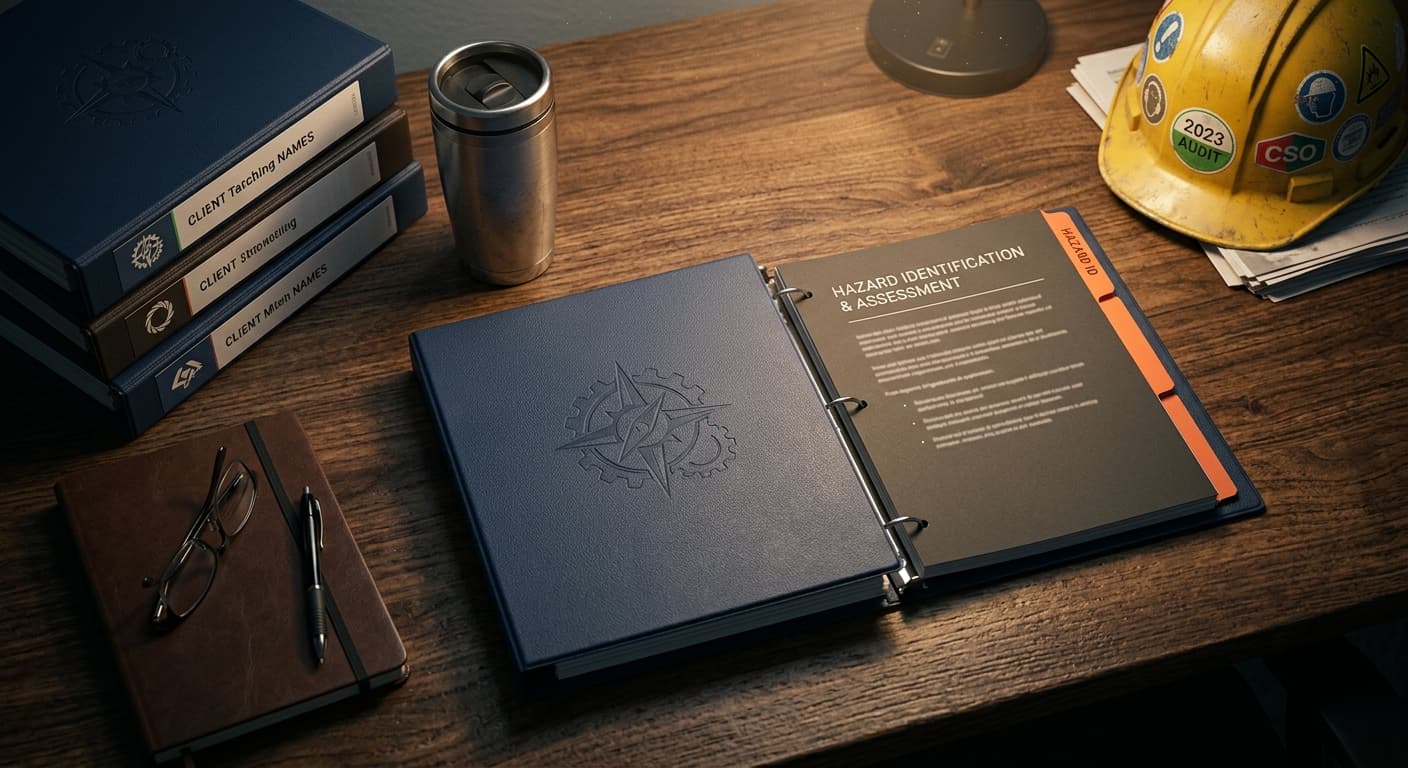
Audit-ready safety manuals built for the certifying partner the company will audit under. 17 core sections, all the forms your type of work needs (branded with your logo), draft within 5 business days. Going for COR? See the COR Ready package.
Read more

COR vs SECOR, explained
Which Certificate of Recognition program fits the operation. Plain-English comparison of audit scope, scoring, and timing.
Read more
Not booking an audit yet?
The Compliance Portal helps you get audit-ready.
Most operators arrive at audit week without the documentation organised. The On-Track Compliance Portal is the workspace that gets your safety program audit-ready in the months before an external auditor walks the site - so when you do book, the paper trail holds up.
One login for your safety manual, worker certificates, training records, audit-prep workspace, and the recurring compliance tasks that keep the program current between audits.
Audit-prep Workspace
ACSA, ESC, and every other Canadian certifying partner's element codes pre-loaded. One-click export to your auditor when the audit week opens.
Document Vault
Your safety manual, JHSC minutes, training records, hazard assessments, and posted notices in one workspace. Indexed and dated.
Compliance Scheduler
JHSC meetings, fire drills, training renewals, posting cycles, insurance expiries. Email alerts before anything lapses.
Cross-framework Evidence Map
One document satisfies multiple frameworks. A workplace violence policy can serve OHSA, an IHSA element, and a WSIB HSEp topic from one upload.
What the auditor will check
Worker certificates, tracked to the day.
Every Working at Heights, First Aid, WHMIS, H2S Alive, and forklift ticket on the worksite needs a paper trail an auditor can follow. The Compliance Members Portal Worker Cert Tracker auto-alerts at 90, 60, 30, and 14 days. No more renewals slipping past the audit window.
Worker Cert Tracker - your roster, your renewal calendar
90, 60, 30, and 14-day expiry alerts. Sample roster shown.
- 1 critical
- 1 renew soon
- 2 schedule
- 0days
S. Tremblay - Roofing Lead
Working at Heights
CriticalAuto-emailed at 14d
- 0days
J. Khalil - Site Foreman
First Aid Level 1
Renew soonAuto-emailed at 14d
- 0days
M. Okonkwo - Welder
WHMIS 2018
ScheduleAuto-emailed at 14d
- 0days
R. Singh - Equipment Op
Forklift
ScheduleAuto-emailed at 14d
- 0days
K. Beaupre - Pipeline Crew
H2S Alive
OKAuto-emailed at 14d
- 0days
A. Hernandez - Excavator Op
Ground Disturbance 201
OKAuto-emailed at 14d
Cert tracking with 90, 60, 30, and 14-day alerts is included from the Foundation tier. OCR-extracted certificate data, worker self-service, and the audit-prep workspace map are unlocked at Compliance tier and above.
Limited remaining-year availability
A couple of spots left. Plan early.
Tell us the certifying partner, the audit cycle stage, and a rough window. We will tell you what is available and what the paper trail looks like before the audit week opens.