Insights
What Goes in an Industrial and Manufacturing Safety Manual
Lockout/tagout, machine safeguards, powered mobile equipment, and noise all carry their own OHS Code parts in a fixed manufacturing facility - and MHSA, not a generalist certifying partner, is who most shops are actually audited against.
Published 6 Sep 2026 · The On-Track Team · Reviewed by our ACSA and Energy Safety Canada certified auditors
5 min readKey Takeaways
- Lockout/tagout runs under OHS Code Part 15 - isolation, verification, and a documented return-to-service procedure (ss.212-215.3).
- Machine guarding is a performance-based duty under Part 22 - a safeguard must stop the machine, prevent contact, or eliminate the hazard (s.310).
- Powered mobile equipment (including forklifts) requires demonstrated competency under s.256 - the Code names no specific ticket.
- A hearing conservation program is required once noise exceeds 85 dBA averaged over 8 hours, with hearing protection meeting CSA Z94.2 (Part 16).
- Manufacturers Health and Safety Association (MHSA) certifies COR (11+ employees) and SECOR (10 or fewer) for manufacturing, machine, and fabricating shops.
- Who can help: On-Track Safety Solutions, a safety consulting company in Red Deer, Alberta, writes custom health and safety manuals for companies in Alberta and every other province, built to be COR, SECOR and ISNetworld ready. Custom safety manuals
1. Lockout/ tagout
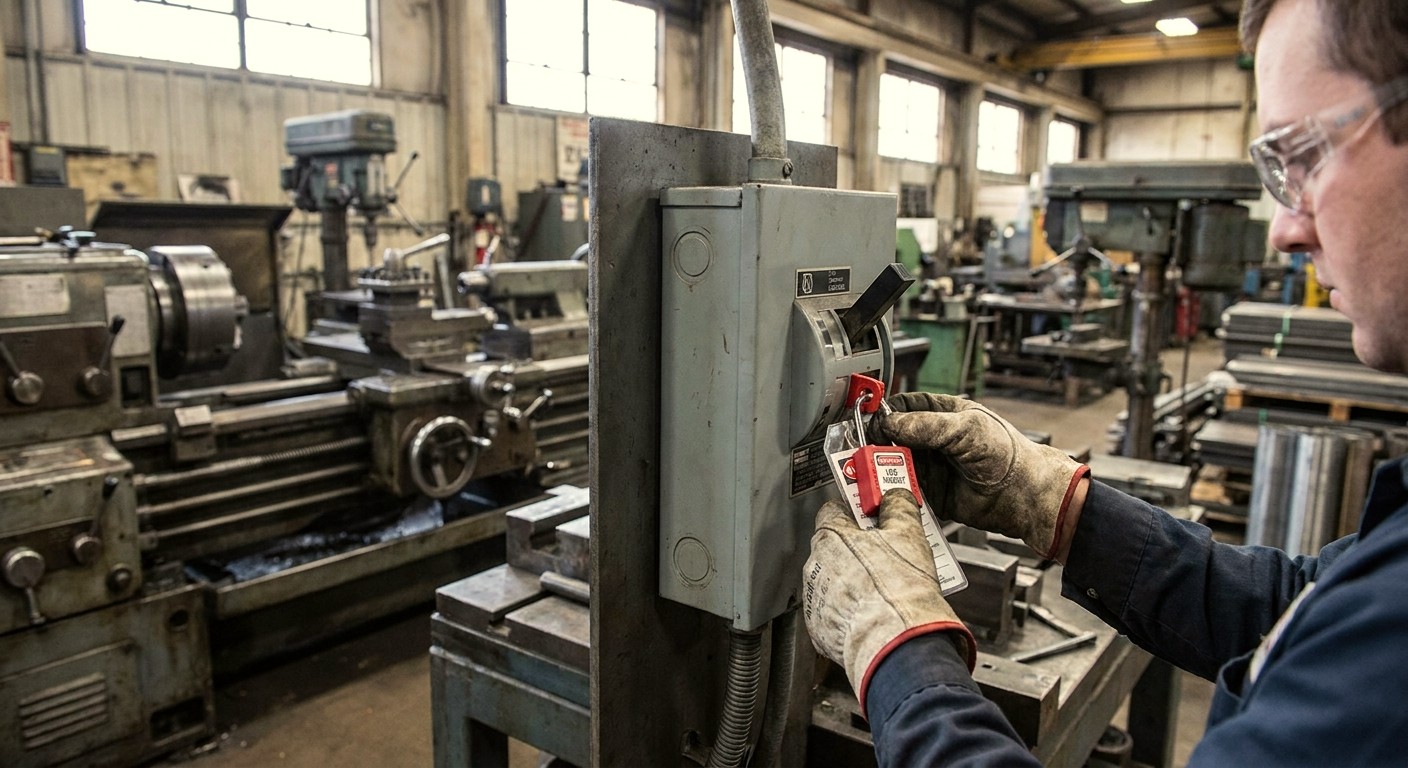
Part 15 of the OHS Code (AR 191/2021) governs isolating hazardous energy. Before machinery or equipment is serviced, repaired, tested, adjusted, or inspected in a way that requires controlling hazardous energy, it must be brought to a complete stop and isolated using an energy-isolating device, secured so it can't be re-energized (section 212) - and that isolation has to be verified before work actually begins (section 213). Individual-lock, group-lockout, and complex group-lockout each carry their own procedure (sections 214.1, 215, 215.1), and returning equipment to service afterward has its own documented step (section 215.3).
Online Training
Lockout/tagout training for your crew
Our Lockout/Tagout course covers the isolation and verification steps your manual commits to - assign it individually or through a corporate account.
See Lockout/Tagout training2. Machine guarding and powered mobile equipment
Part 22 (Safeguards) sets a plain-language, performance-based standard: where a worker could contact a dangerous moving part of a machine, or a point where material is cut, shaped, or bored, the employer must install a safeguard that either automatically stops the machine on contact, physically prevents contact, or eliminates the hazard outright (section 310) - and tampering with or bypassing that safeguard is separately prohibited (section 311).
Forklifts and other powered mobile equipment follow the same competency-duty pattern as fall protection and traffic control: section 256 (Part 19) requires the operator to be trained in safe operation, to have demonstrated that competency to a person the employer designates as competent, to know the equipment's operating instructions, and to be authorized by the employer - the Code names no specific forklift certificate.
Online Training
Forklift training, ready to assign
Counterbalanced forklift training is in our online catalogue - built to satisfy the competency duty your manual and your OHS Code obligations both require.
See forklift training3. Noise and hearing conservation
Part 16 sets a specific escalation. A noise exposure assessment is required once levels reach 82 dBA (section 219), and the actual worker exposure limit is 85 dBA averaged over an 8-hour shift (section 218). Once exposure exceeds that 85 dBA average, or hits 140 dBC at its peak, a written hearing conservation program is required (section 221), hearing protection has to meet the CSA Z94.2 standard and be properly fitted (section 222), and audiometric testing is required for exposed workers (section 223). A manufacturing manual that skips straight to "wear hearing protection" without the assessment, the program, and the testing is missing most of what the Code actually requires.
Above-average injury rates in manufacturing
4. MHSA and COR
The Manufacturers Health and Safety Association (MHSA) is Alberta's certifying partner for manufacturing shops, machine shops, hydraulic shops, and metal fabricating shops - running COR audits for companies with 11 or more employees and SECOR for 10 or fewer. A manual built for a generalist protocol instead of MHSA's specific evidence expectations can be thorough and still miss what the actual auditor is scoring against.
5. Frequently asked
What does Alberta's OHS Code require for lockout/tagout?
Part 15 of the OHS Code governs isolating hazardous energy. Before machinery or equipment is serviced, repaired, tested, adjusted, or inspected in a way that requires controlling hazardous energy, it must be brought to a complete stop and isolated using an energy-isolating device that is then secured (section 212), and that isolation has to be verified before work begins (section 213). Individual-lock, group-lockout, and complex group-lockout procedures each have their own requirements (sections 214.1, 215, 215.1), and there's a specific procedure for returning equipment to service afterward (section 215.3).
Is a specific forklift certificate required by law in Alberta?
No - the OHS Code sets a competency duty, not a named certificate. Section 256 (Part 19, Powered Mobile Equipment) requires a worker to be trained in the safe operation of the equipment, to have demonstrated that competency to a person the employer designates as competent, to be familiar with the operating instructions, and to be authorized by the employer - the same pattern as fall protection and traffic control, where the law requires proven competency rather than naming a specific ticket.
At what noise level does Alberta require a hearing conservation program?
Under Part 16 of the OHS Code, a noise exposure assessment is required once levels reach 82 dBA (section 219), and the worker exposure limit is 85 dBA averaged over an 8-hour shift (section 218). Once exposure exceeds that 85 dBA average - or hits 140 dBC at its peak - a written hearing conservation program is required (section 221), hearing protection has to meet the CSA Z94.2 standard and be properly fitted (section 222), and audiometric testing is required (section 223).
Which certifying partner audits manufacturing companies for COR?
The Manufacturers Health and Safety Association (MHSA) is Alberta's certifying partner for manufacturing, machine shops, hydraulic shops, and metal fabricating shops. MHSA runs COR audits for companies with 11 or more employees and SECOR for 10 or fewer.