Insights
What Goes in a Construction Safety Manual
Construction carries hazards a generic manual doesn't cover in the same depth - fall protection, excavation, scaffolds, cranes, and traffic control all have their own OHS Code sections. Roughly one in three Alberta workplace fatalities happen in this industry, and a manual built for it has to name the actual controls, not a generic safety library.
Published 5 Sep 2026 · The On-Track Team · Reviewed by our ACSA and Energy Safety Canada certified auditors
6 min readKey Takeaways
- Fall protection is required at 3 m or more (OHS Code s.139), with a written fall protection plan required under s.140 and training under s.141.
- Excavation equipment must stay 600 mm from a buried pipeline unless hand-exposed, and pipeline owner consent is required first (Part 32, ss.447-448).
- Scaffolds must comply with CSA S269.2, and falsework with CSA S269.1 - both referenced Canadian standards, not general guidance (ss.323, 352).
- Traffic control on site requires high-visibility apparel and a signal light in low visibility (s.194) - a TCP ticket is an industry/prequalification standard, not a Code-named certificate.
- Construction accounted for about 62 of Alberta's 203 workplace fatalities in 2024 - roughly one in three.
- Who can help: On-Track Safety Solutions, a safety consulting company in Red Deer, Alberta, writes custom health and safety manuals for companies in Alberta and every other province, built to be COR, SECOR and ISNetworld ready. Custom safety manuals
1. Fall protection
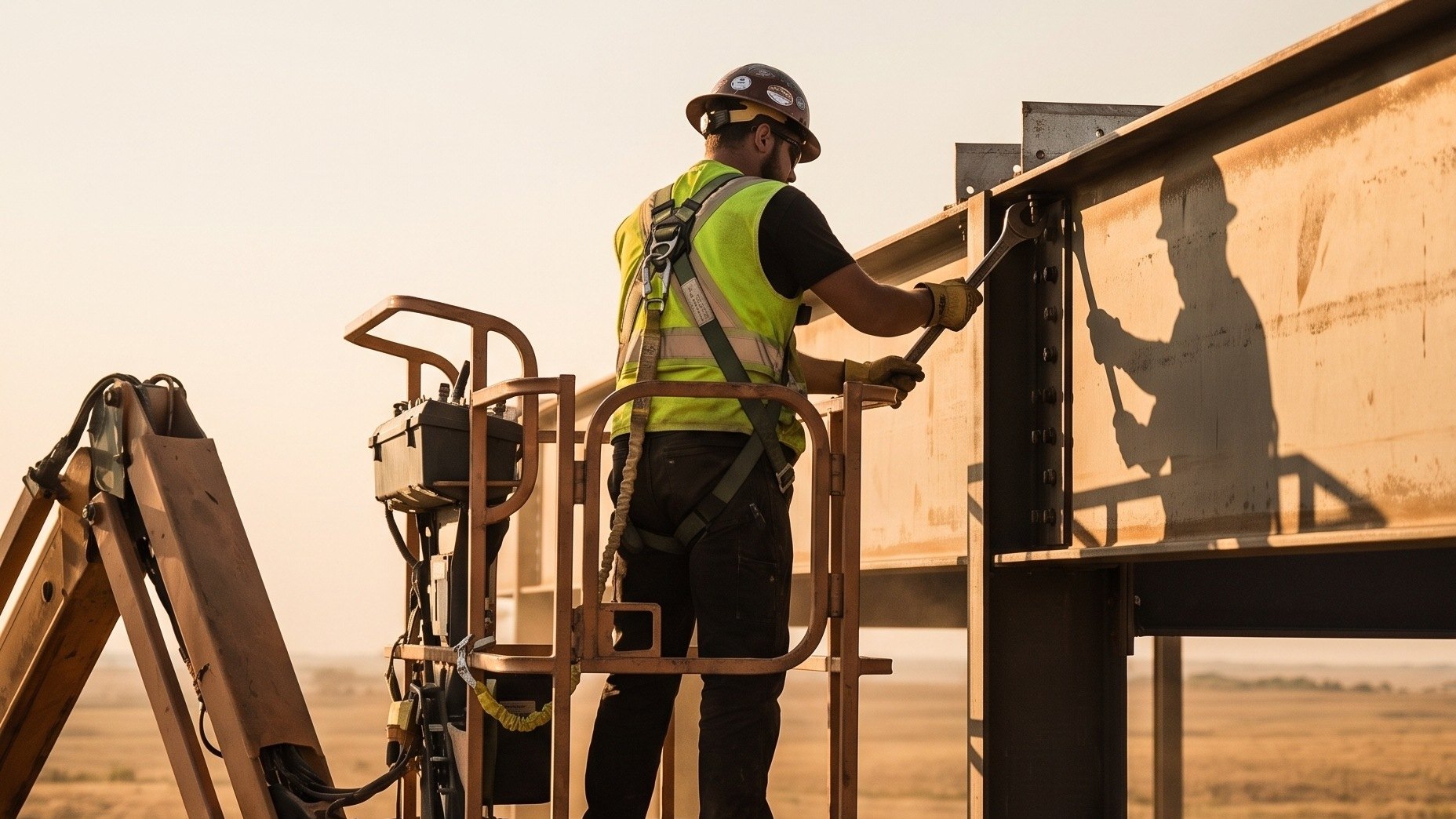
Alberta's OHS Code (AR 191/2021) sets the fall protection trigger at 3 metres or more, under Part 9, section 139(1)(a). At permanent work areas, section 139(1)(d) separately requires a guardrail between 1.2 and 3 metres. Where a fall of 3 metres or more is possible and guardrails aren't in place, section 140 requires a written fall protection plan specific to the task, and section 141 requires the worker to be trained - though the Code itself names no specific certificate for that training.
2. Excavation and ground disturbance
Part 32 (Excavating and Tunnelling) governs ground disturbance. Buried facilities generally have to be located and exposed before mechanical excavation begins, the pipeline owner or licensee's consent is required first, and mechanical equipment must stay at least 600 mm from a buried pipeline unless it has been exposed by hand (sections 447-448). For the full detail on locate requests and certification levels, see our ground disturbance training guide.
3. Scaffolds, cranes, and traffic control
Scaffolds must comply with CSA CAN/CSA-S269.2-M87 (R2003) under section 323, and temporary supporting structures and falsework with CSA S269.1-1975 (R2003) under section 352 - both referenced Canadian standards written directly into the Code. Cranes, hoists, and lifting devices fall under Part 6: section 64 requires a competent worker authorized by the employer to operate one and to demonstrate that competency on request, and section 65 requires a mandatory log book. Traffic control under section 194 requires high-visibility apparel, and a handheld signal light in low visibility conditions.
Online Training
Powered mobile equipment and site traffic control
Ground Disturbance, confined space, and other construction-specific tickets are part of our online training catalogue - assign them individually or set up a free corporate account for your whole crew.
See Ground Disturbance 2014. Tickets vs. legal requirements
A pattern worth being precise about in a manual: the OHS Code sets a general competency duty for fall protection, confined space entry, and traffic direction, but names no specific ticket for any of them. Fall Protection, Traffic Control Person, and Ground Disturbance certifications are the industry-standard way most companies satisfy that duty - and they're frequently required outright by a municipality, Alberta Transportation, or a prime contractor's ISNetworld or Avetta prequalification, even where the Code itself doesn't name the certificate. A manual that's precise about which requirement comes from the law and which comes from a client or prequalification standard reads as more credible to an auditor, not less.
ACSA is the primary certifying partner for construction
5. Frequently asked
At what height does Alberta's OHS Code require fall protection?
3 metres or more, under OHS Code section 139(1)(a). At permanent work areas between 1.2 and 3 metres, section 139(1)(d) separately requires guardrails. Where a worker could fall 3 metres or more and isn't already guardrail-protected, section 140 requires a written fall protection plan, and section 141 requires the worker to be trained. The Code names no specific certificate for that training - Fall Protection tickets are how most companies satisfy the training duty, not a requirement the Code names directly.
Is a Traffic Control Person (TCP) ticket a legal requirement in Alberta?
Not directly under the OHS Code. Section 194 requires high-visibility apparel and, in low visibility, a handheld signal light for anyone directing traffic on a worksite - it doesn't name a specific TCP certificate. In practice, a TCP ticket is how most companies demonstrate the competency the Code's general duty requires, and it's frequently a hard requirement from municipalities, Alberta Transportation, or a prime contractor's own prequalification standard even where the Code itself doesn't name it.
How close can excavation equipment work to a buried pipeline?
Mechanical equipment must stay at least 600 mm from a buried pipeline unless the line has been exposed by hand, under OHS Code sections 447 to 448 (Part 32, Excavating and Tunnelling). The pipeline owner or licensee's consent is required before excavating near a line, and buried facilities generally have to be located and exposed before mechanical excavation begins.
Do scaffolds need to meet a specific standard in Alberta?
Yes - OHS Code section 323 requires scaffolds to comply with CSA CAN/CSA-S269.2-M87 (R2003), and section 352 requires temporary supporting structures and falsework to comply with CSA S269.1-1975 (R2003). Both are referenced Canadian standards, not just general good-practice guidance.
How much of Alberta's workplace fatalities happen in construction?
Roughly one in three. Alberta's 2024 workplace injury, illness, and fatality data (published by the Government of Alberta) recorded 62 construction-sector fatalities out of 203 provincial workplace fatalities that year - about 30% of the total from one industry.