Insights
What Goes in a Trucking Safety Manual
A trucking or transportation safety manual runs on the National Safety Code, not the general OHS framework alone - vehicle inspection thresholds, hours of service, and driver files all carry their own rules. Getting the provincial-versus-federal distinction wrong is the single most common - and most consequential - mistake we see.
Published 5 Sep 2026 · The On-Track Team · Reviewed by our ACSA and Energy Safety Canada certified auditors
6 min readKey Takeaways
- Vehicle inspection is only a legal duty for commercial vehicles over 4,500 kg (federal) or over 11,794 kg (Alberta intra-provincial) - every 24 hours under NSC Schedule 1.
- Alberta's own hours-of-service rules (AR 317/2002) are not the same as the federal rules (SOR/2005-313) - longer on-duty hours, no cycle limits, higher weight threshold.
- Your Alberta Safety Fitness Certificate states your carrier's Provincial or Federal operating status - the fastest way to know which rules apply.
- The jurisdiction test is whether extra-provincial operation is continuous and regular - there's no minimum percentage that triggers federal status.
- AMTA is the primary COR certifying partner for trucking in Alberta.
- Who can help: On-Track Safety Solutions, a safety consulting company in Red Deer, Alberta, builds National Safety Code (NSC) programs for trucking and commercial vehicle operators in Western Canada and trains drivers on the required NSC courses. NSC programs for trucking companies
1. Vehicle inspection thresholds
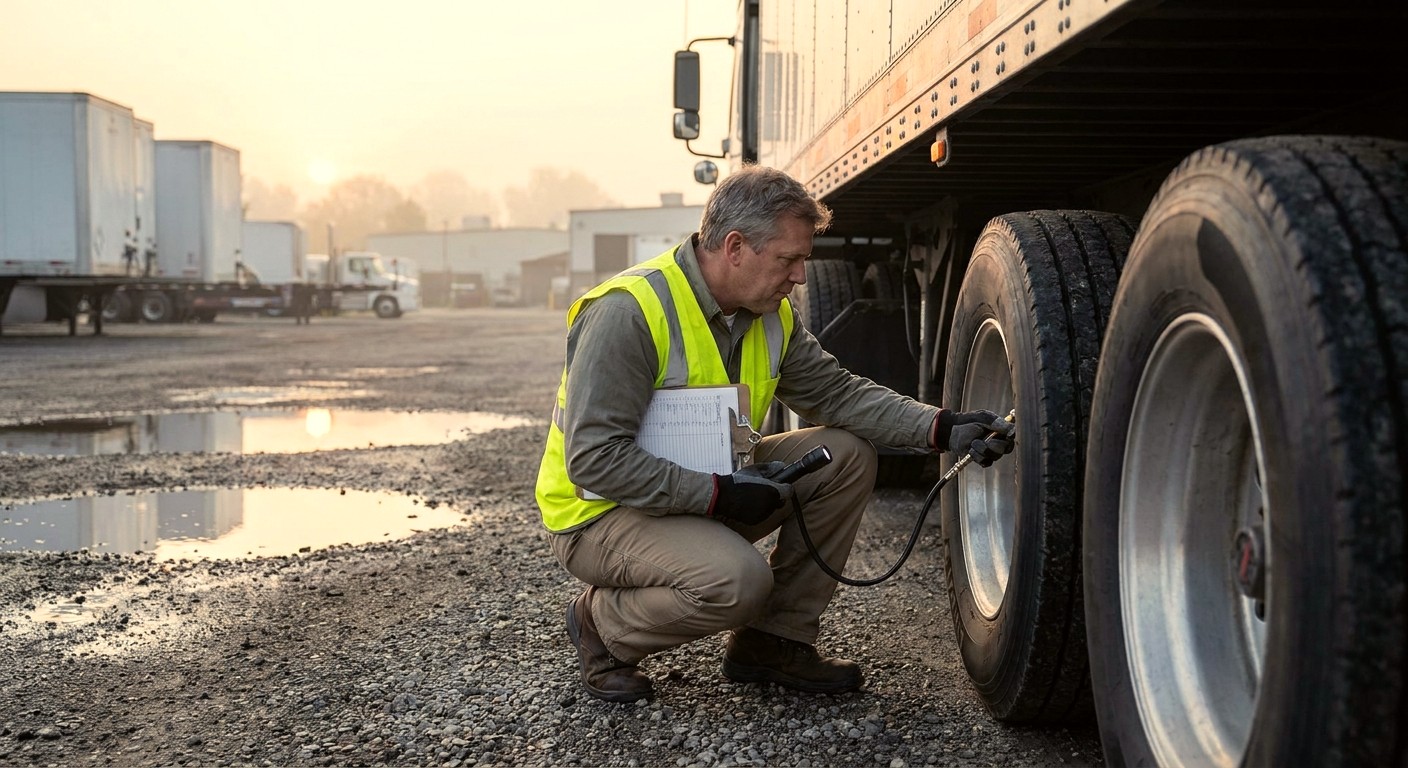
A surprising number of manuals get this backwards. Light vehicles - pickups, vans, cars - carry no legal daily inspection requirement; a visual walkaround before use is good practice, not a duty. A commercial vehicle registered over 4,500 kg owes a trip inspection every 24 hours under NSC Schedule 1, and that one is a real legal duty that a manual should never soften into “as needed” or leave off a frequency entirely.
A common two-way mistake
2. Provincial vs federal hours of service
Alberta's Drivers' Hours of Service Regulation (AR 317/2002) was never harmonized with the federal regulation (SOR/2005-313), and the differences are real enough to matter in a manual:
| Rule | Federal (SOR/2005-313) | Alberta intra-provincial (AR 317/2002) |
|---|---|---|
| Driving | 13 h | 13 h |
| On duty | 14 h | 15 h |
| Elapsed window | 16 h | Does not exist |
| Daily off duty | 10 h total, 8 h consecutive | 8 h consecutive, no 10 h total |
| Cycles | 70 h / 7 days, 120 h / 14 days | None at all |
| Weight threshold | Over 4,500 kg | Over 11,794 kg |
Getting this wrong in either direction is a problem. Writing the looser Alberta numbers into a manual for a carrier that regularly crosses into BC or Saskatchewan understates a real legal duty - and Alberta courts have held that even a mostly in-province carrier counts as federally regulated once crossing the border becomes a continuous, regular part of the operation, not an occasional exception. There's no minimum percentage of loads that triggers it.
The fastest way to check
3. Driver files and NSC compliance
Beyond inspection and hours, a compliant transportation manual documents the driver file requirements that sit under the National Safety Code - abstract checks, medical certification tracking, and log retention - along with Transportation of Dangerous Goods (TDG) training where the fleet actually hauls dangerous goods, rather than a blanket requirement applied to drivers who never do.
Online Training
NSC Overview and TDG training, ready to assign
Our National Safety Code Overview and Transportation of Dangerous Goods courses cover the driver-file side of this - built for Canadian carriers, not a generic US-market course relabelled.
See NSC and TDG courses4. Getting the manual right
A transportation-specific section built into a custom safety manual - rather than a generic template with a trucking chapter bolted on - reflects your actual operating status, your actual weight class, and the certifying partner you're audited against. In Alberta, that's typically the Alberta Motor Transport Association (AMTA); companies running into BC or Saskatchewan should confirm the equivalent partner in each additional province.
5. Frequently asked
Does every company vehicle need a daily inspection?
No. A light vehicle - a pickup, van, or car - has no legal daily inspection requirement; a visual walkaround before use is good practice, not a legal duty. A commercial vehicle registered over 4,500 kg owes a trip inspection every 24 hours under NSC Schedule 1, and that one is a legal duty that shouldn't be softened or made optional in a manual. Mixing the two up - requiring a full inspection on every pickup, or missing it entirely on the heavy trucks - is a common manual defect.
Are Alberta's hours-of-service rules the same as the federal ones?
No, and this is one of the most consequential things to get right in a transportation manual. Alberta's own Drivers' Hours of Service Regulation (AR 317/2002) is not harmonized with the federal regulation (SOR/2005-313) - it allows a longer on-duty day, has no weekly or bi-weekly cycle limit at all, and applies at a higher vehicle-weight threshold. A manual that states federal numbers for a company that only operates within Alberta is describing a stricter standard than the one that actually applies - and a manual that states Alberta's looser numbers for a company that regularly crosses into BC or Saskatchewan is describing a standard that is not strict enough, which is the more serious error.
How do I know if my fleet is provincially or federally regulated?
The fastest check is your Alberta Safety Fitness Certificate, which states the carrier's operating status as Provincial or Federal. The underlying test is whether extra-provincial operation is continuous and regular - there's no minimum percentage of loads that triggers it, and Alberta courts have held a carrier federal even when most of its work stayed in-province, as long as crossing the border was a regular part of the operation rather than a one-off.
Which certifying partner audits a trucking company's COR?
In Alberta, the Alberta Motor Transport Association (AMTA) is the primary certifying partner for trucking and transportation. Companies operating in British Columbia or Saskatchewan as well should confirm the equivalent partner in each province, since a multi-province carrier's manual and audit path needs to reflect all of them.