A module-by-module look at what a Leadership for Safety course actually teaches Canadian supervisors, from hazard assessment and incident investigation to the documentation an audit expects to see.
"Leadership for Safety" is the name a lot of Western Canadian employers use for supervisor-level safety training, whether it is run in-house, through a certifying partner, or delivered by a consultant. The name suggests something abstract, but the actual course content is not abstract at all. It is a specific set of skills a supervisor needs to run a crew, document what happened on site, and catch problems before they become incidents.
This post walks through what is actually taught, module by module, and who in an organisation should be sitting in the room. If you are trying to figure out whether this training is legally required for your supervisors, or whether it is worth the cost, those are separate questions covered elsewhere. Here we are only answering: what is on the syllabus.
Who the course is built for
The target audience is anyone who directs the work of others on site, not just people with "supervisor" in their job title. That includes new forepersons stepping up from the crew, site managers running multiple trades, leads on small teams, and owner-operators who both work in the field and direct a handful of employees. A common scenario in Alberta and BC is a company that grows from three workers to eight or nine, and the owner suddenly needs to formalise duties that used to happen informally.
Companies pursuing COR or SECOR certification also send existing supervisors through this training as part of building out their management system, since auditors want to see that people in supervisory roles have documented safety training beyond their trade certification.
Hazard recognition and assessment
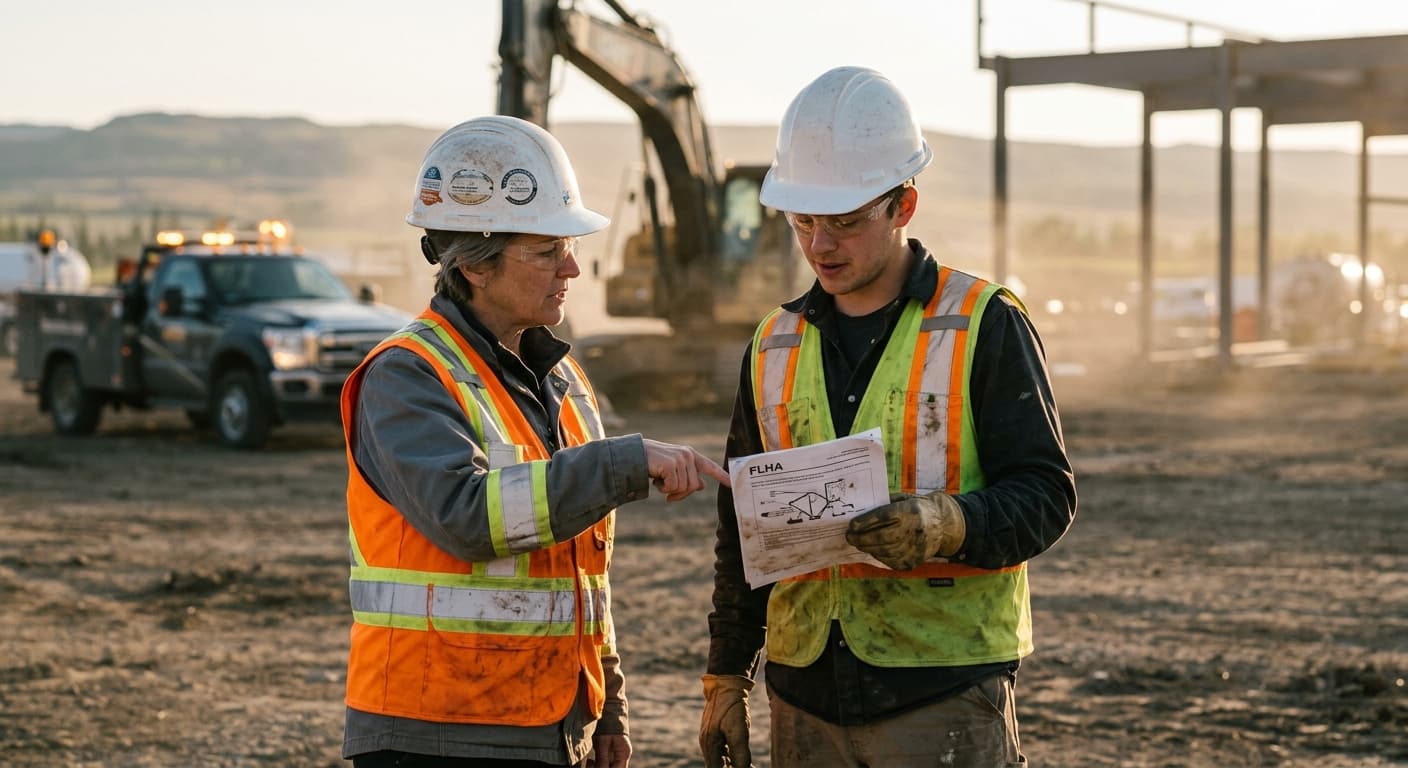
This is usually the largest single block of the course. Supervisors are taught how to run a formal field-level hazard assessment (FLHA), not just fill one out from memory. That means walking the task, identifying hazards specific to that day's conditions, weather, and crew, and matching controls to each hazard rather than writing generic phrases like "be careful."
- How to distinguish a hazard from a risk and rate severity versus likelihood
- Reading and applying WHMIS 2015 labels and safety data sheets when a supervisor, not a worker, is responsible for controls
- Recognising near misses as reportable events, not just recordable injuries
- Sign-off procedures: what a supervisor's signature on a hazard assessment actually attests to
Incident investigation basics
Supervisors are almost always the first person on scene after an incident, and the course spends real time on what to do in the first hour: securing the scene, taking statements while memories are fresh, and separating the immediate cause from the root cause instead of stopping at "worker error."
Trainees practice writing an incident report that a safety manager or auditor can actually use, meaning it names the corrective action, assigns an owner, and sets a follow-up date rather than closing the loop with a vague promise to "reinforce training." Poorly written investigation reports are one of the most common gaps On-Track sees when reviewing a client's documentation.
Orientations, toolbox talks, and daily communication
A supervisor's day-to-day safety leadership is mostly communication, and the course treats it that way. This module covers running a worker orientation that actually transfers site-specific hazard knowledge rather than just having someone sign a checklist, and how to structure a toolbox talk so it addresses the actual task ahead instead of reading a generic topic off a card.
- Structuring a five-minute toolbox talk around the day's specific work, not a canned topic
- Documenting attendance and content so the talk holds up as a training record later
- Running a new-worker orientation and confirming comprehension, not just signature
- Escalation language: how a supervisor stops a task without undermining production goals
A recurring theme across course versions: a supervisor's authority to stop unsafe work is only as good as their ability to document why they stopped it. Training that skips the paperwork side leaves that authority untested until it matters.
Progressive discipline and coaching
Most courses include a module on corrective conversations, since supervisors are frequently the ones who have to address unsafe behaviour without a human resources background. This covers the difference between coaching a first-time slip and documenting a repeated violation, how to write up a conversation so the record is defensible later, and how to keep a correction focused on the behaviour rather than the person.
Documentation supervisors are expected to produce
By the end of the course, a supervisor should know exactly what paperwork their role generates: hazard assessments, orientation records, toolbox talk minutes, inspection sign-offs, and incident reports. This matters beyond day-to-day operations. If your company is working toward COR or SECOR certification, an auditor will ask to see evidence that supervision is actually happening, not just claimed. Custom orientation packages and digital form platforms like SiteDocs make this documentation easier to produce consistently, which is why courses increasingly spend time on the tools, not just the theory.
How it is usually delivered
Length and format vary by provider. Some versions run as a single half-day session focused on the basics, others run over one or two full days and include a practical assessment or written test. Online delivery has become common for the theory-heavy modules, with in-person or field components reserved for hazard assessment practice and mock investigations. If you are building safety leadership training into a broader safety management system, it is worth pairing it with your safety manual and custom orientation content so supervisors are trained on the same documents they will be expected to use on site, rather than generic material that does not match your actual forms.
For companies not sure whether their current supervisors have covered these topics, a straightforward way to check is to compare this list against what your existing training records show. Gaps usually show up in incident investigation writing and hazard assessment quality before anywhere else, since those are the skills that get the least practice until they are needed.