Most near-miss reporting systems collect dust because workers fear blame or never see a fix. Here is how to build one that catches the next incident before it happens.
A near miss is the truck that almost backed into a labourer, the scaffold plank that cracked but held, the chemical splash that missed skin by inches. Nothing got hurt, nothing got reported to WCB, and on most sites nothing gets written down either. That is the problem. A near miss is a free lesson about a hazard that is still live on your site, and most companies throw it away.
This post is not about incident investigation after someone is hurt. It is about the reporting system that sits upstream of that, the one that catches the close call before it becomes the claim. Building that system well is less about the form you use and more about whether workers trust what happens after they fill it out.
Why near misses are your best leading indicator
Lagging indicators, like your recordable injury rate or your WCB claim costs, tell you what already went wrong. Near misses tell you what is about to go wrong while you still have time to fix it. The hazard that almost caused a fall from height today is the same hazard that will cause one eventually if nobody addresses it. A near miss is that hazard announcing itself for free, without a lost-time claim attached.
Every job hazard assessment, every formal hazard identification process, is built on knowing what actually happens on site, not just what the procedure says should happen. A steady flow of near-miss reports is one of the few real-time windows into that gap. Without it, you are relying on workers to mention things informally in the lunchroom, or on the hazard resurfacing in a way serious enough that it cannot be ignored.
Why most near-miss systems fail
Almost every company we work with in Alberta, BC, Saskatchewan, and Manitoba already has a near-miss form somewhere, in a binder, on a laminated card, in a digital form nobody opens. The form is rarely the problem. Two things kill participation every time.
Fear of blame
If the last person who reported a close call ended up in a conversation with their supervisor about why they were in that situation in the first place, that story travels fast. Workers are not naive. They will stop reporting the moment reporting starts to feel like confession. A near-miss system that quietly functions as a discipline pipeline will produce fewer and fewer reports over time, and management will misread the silence as improving safety performance.
No visible follow-up
The second killer is just as common and less talked about. A worker fills out the form, and nothing visibly happens. No fix, no update, no acknowledgement. From the worker's side, that report went into a black hole. Reporting takes effort and a small amount of social risk, and if the return on that effort is silence, most workers will decide it was not worth it the second time around, even if the first report was handled fine and they just never heard about it.
If a worker cannot point to something on site that changed because of a near-miss report, your system is not working, no matter how many reports are on file.
Building a system workers actually use
Keep the report itself simple
A near-miss report should take under two minutes to complete on the floor or in the field, not at a desk later. That means short fields: what happened, where, what could have happened, and what needs to change. Long narrative sections and multiple sign-off boxes belong in a formal incident investigation, not here. If workers need to track someone down or log into a system with a forgotten password to report a close call, most of them will just mention it verbally and move on, and verbal reports do not build a trend line.
A digital form on a phone, filled out on the spot, beats a paper form filed away for the safety coordinator to find later. On-Track is an authorised referral partner for SiteDocs, which handles this kind of field-level digital reporting, and we can walk you through what a simple mobile near-miss form looks like if you want to see one in practice.
Protect the no-blame culture deliberately
No-blame does not happen by declaring it in a policy statement. It happens because supervisors are trained to respond to every near-miss report the same way, with curiosity about the hazard, not with questions aimed at the worker's judgement. That distinction has to be trained into frontline supervisors specifically, because they are the ones present in the moment a report comes in, and their reaction in the first sixty seconds sets the tone for every report that follows from that crew.
There is one legitimate exception: near-miss reporting is not blanket immunity for reckless or wilful violations of a documented safety rule. But that line needs to be drawn narrowly and applied consistently, or workers will assume it applies to them by default and stop reporting anything that makes them look bad, which in practice is most near misses.
Track corrective action where workers can see it
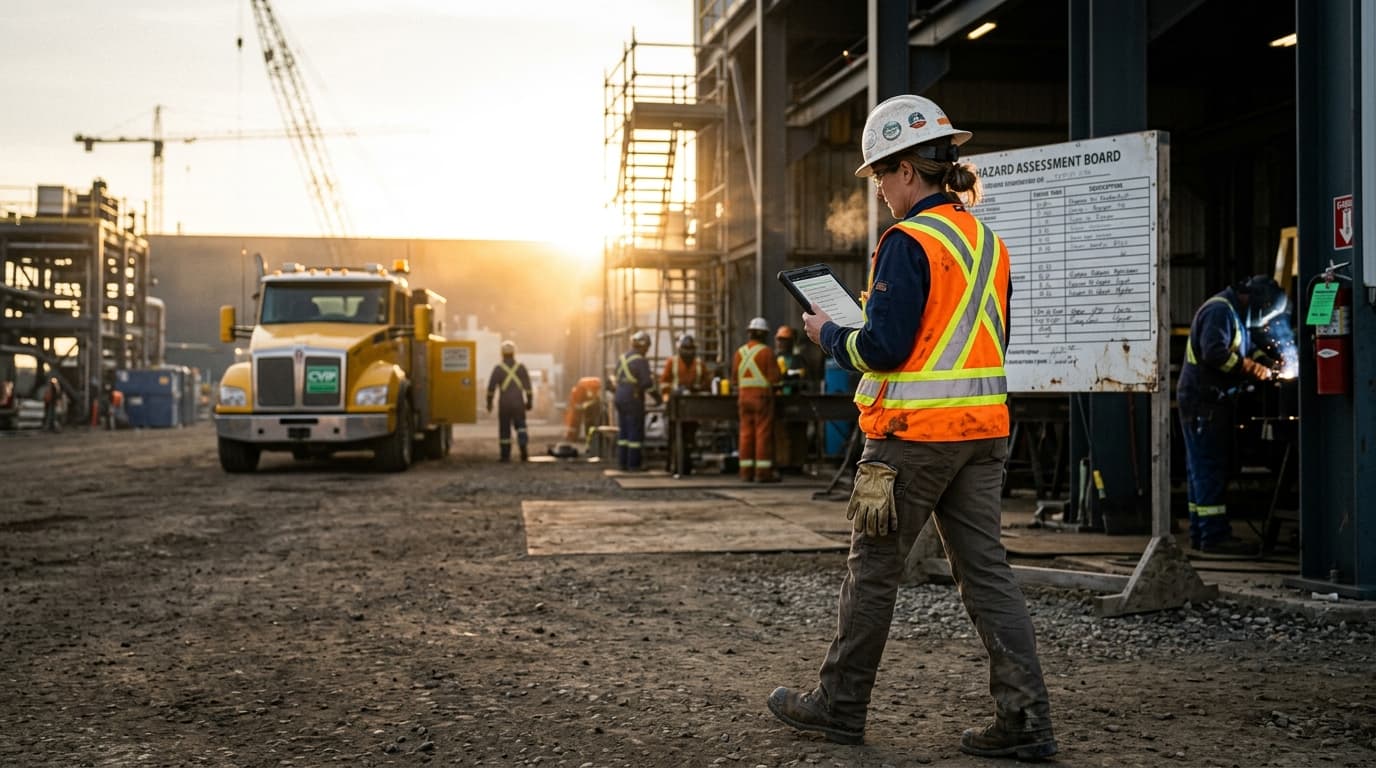
This is the step most companies skip, and it is the one that actually determines whether the system survives past its first few months. Every near-miss report needs a corrective action assigned to a specific person with a target date, tracked in the same place the hazard assessments and inspection findings live, not in a separate spreadsheet nobody checks. When the fix is done, close the loop visibly, on the safety board, in a toolbox talk, in whatever channel the crew already pays attention to. It does not need to name who reported it. It needs to show that the report led to something concrete.
Where this fits into COR and SECOR
Hazard identification and control is a core element of the COR and SECOR audit standards across Western Canada, whether you are certifying through ACSA or Energy Safety Canada in Alberta or an equivalent certifying partner in BC, Saskatchewan, or Manitoba. An auditor reviewing your program wants to see more than a policy document. They want evidence that hazards get identified, tracked, and closed out, and a working near-miss system with dated corrective actions is some of the clearest evidence you can put in front of them. A binder of near-miss forms with no follow-up documented is close to worthless for audit purposes, which is another reason the corrective-action tracking piece matters as much as the reporting piece.
Getting started
- Cut your existing near-miss form down to the fields a worker can complete in under two minutes.
- Put the form somewhere workers already are, on a phone or a jobsite tablet, not filed away in an office.
- Train supervisors specifically on how to respond to a report without making it about the worker.
- Assign every report a corrective action, an owner, and a due date, tracked alongside your other hazard assessment documentation.
- Post closed-out fixes somewhere the crew sees them, even briefly, at a toolbox talk or on the safety board.
None of this requires new software or a big budget. It requires a form people trust, a response that does not punish honesty, and a habit of showing your work once the fix is in. If you want a second set of eyes on how your near-miss reporting would hold up under a COR or SECOR audit, or you want help setting up field-level digital reporting through SiteDocs, get in touch and we can look at what you have.</p>