
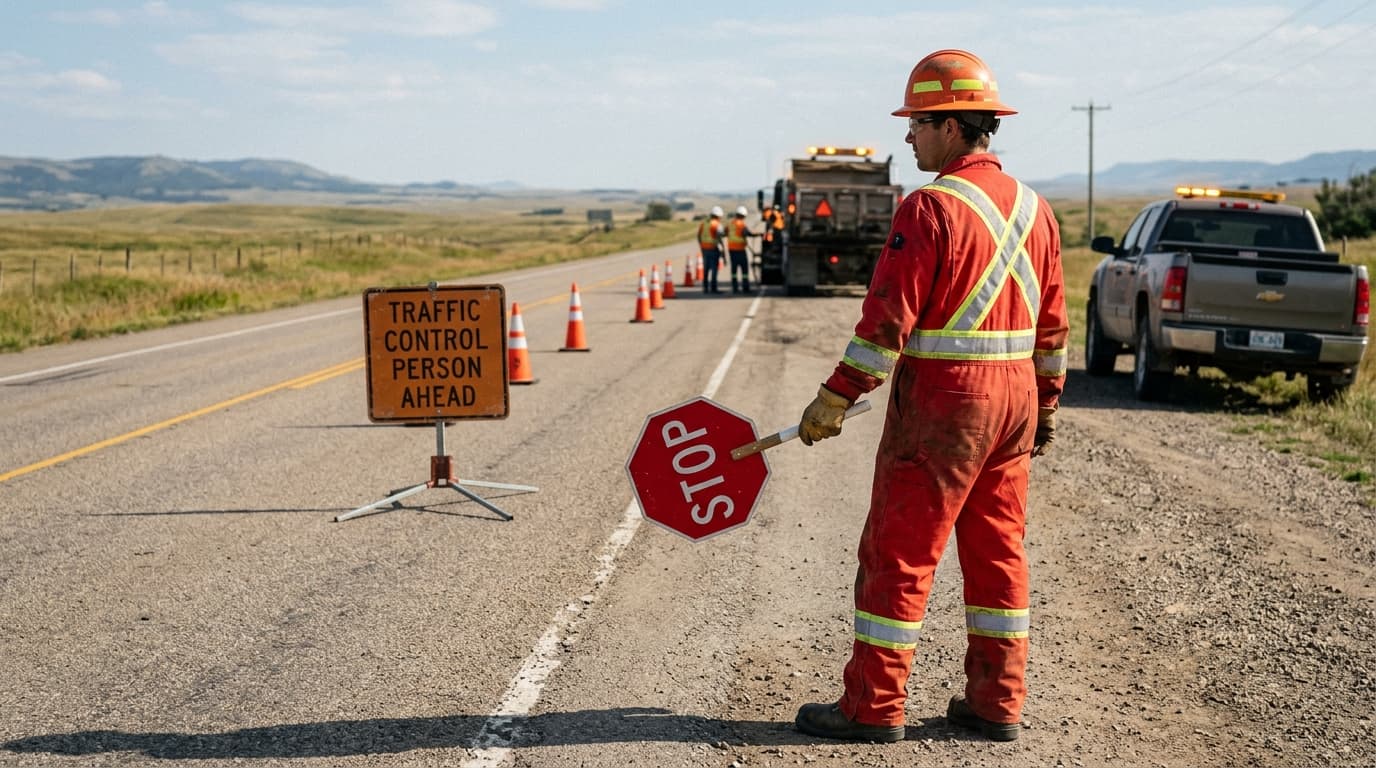
A working traffic control plan is a written document, not a box of pylons. Here is what Canadian construction and roadwork sites need for signage, flagger certification, and pedestrian separation, plus the gaps auditors flag most often.
A traffic control plan (TCP) is not the pylons you set out Monday morning. It is a written document that maps out how vehicles, equipment, and pedestrians move around a work zone before the first sign goes up, and it is one of the first things a COR or SECOR auditor asks to see when traffic control shows up as a hazard on your site.
Most operations that get dinged on traffic control are not running unsafe sites. They are running sites where the plan lives in the supervisor's head instead of on paper, or where the flagger holding the sign has never actually been certified. Both are easy to fix once you know exactly what an auditor, or a police officer doing a roadside check, is looking for.
What actually has to be in a written TCP
A traffic control plan needs to show the work zone in relation to the road: taper lengths, sign placement and sequence, the buffer or work space, and where workers and equipment sit relative to moving traffic. It should identify the posted speed limit, the reduced work zone speed if one applies, and who has authority to shut the plan down if conditions change, such as poor visibility or a flagger going off shift with no replacement briefed.
The plan also needs to name the standard it is built from. In Alberta that is typically the province's Traffic Accommodation in Work Zones manual; other provinces publish their own equivalent manuals with their own approved sign layouts and taper formulas. Whichever manual applies to the job, the TCP should reference it directly rather than leaving sign placement to memory or habit.
- Site sketch or diagram showing sign sequence, taper, and buffer zone
- Posted speed and work zone speed, with the reduction method noted (signs, flaggers, or both)
- Named person with authority to stop work and shut down the zone
- Reference to the applicable provincial traffic control manual
- Review date and revision trigger, such as a change in traffic volume or road geometry
Signage: sequence matters as much as the sign
Auditors and inspectors do not just check that signs exist, they check that the sequence is correct. Advance warning signs need to appear far enough ahead of the work zone to give drivers time to react, the taper needs to funnel traffic smoothly rather than forcing a last second lane change, and termination signage needs to tell drivers clearly when they are back to normal conditions. A single missing or out of sequence sign, like a taper sign placed after the taper instead of before it, is a common finding.
Signs also need to match the actual conditions on site. A crew running a reduced speed zone with no speed sign posted, or a sign left up advertising a hazard that was cleared two days ago, both read as a control that exists on paper but is not maintained in the field. Whoever is responsible for the site each shift should be doing a quick signage walk as part of their daily check, not relying on the original setup from when the job started.
Flagger certification: who can actually direct traffic
A flagger directing traffic on a public roadway needs recognized traffic control person (TCP) certification, not just a stop-slow paddle and a safety vest. Certification is delivered through recognized training providers in each province and typically needs to be renewed on a set cycle, so a flagger card that expired two years ago does not satisfy the requirement even if the worker still remembers the hand signals.
High visibility apparel matters here too. Flaggers and anyone working within the traffic control zone should be wearing high visibility gear that meets the applicable CSA standard, not a faded vest pulled out of a truck box. On a night job or in low light, that distinction is the difference between a driver seeing a person early enough to slow down and not seeing them at all.
Keep flagger certification cards, expiry dates, and high visibility apparel checks in one place your supervisors can pull up on demand. An auditor asking to see a flagger's card mid-audit and getting a blank look from the supervisor is one of the fastest ways a traffic control question goes from a pass to a gap.
Separating pedestrians from vehicles and equipment
Traffic control on a construction site is not only about the public roadway. Inside the work zone, pedestrian workers need a defined path that keeps them out of equipment swing radius, backing zones, and haul routes. This is where a lot of TCPs go quiet, they cover the road-facing signage in detail and say nothing about how a worker on foot gets from the gate to the trailer without crossing an active haul road.
Practical separation usually means a marked walkway, physical barriers where equipment and foot traffic would otherwise cross, and a rule that pedestrians do not enter an active equipment zone without eye contact or radio confirmation with the operator. On sites with mobile equipment, spotters and clearly defined equipment exclusion zones do more to prevent a struck-by incident than any amount of signage aimed at the public road.
What auditors actually flag
Across COR and SECOR audits, traffic control questions tend to fail for a short list of repeat reasons rather than anything exotic. Knowing the list ahead of time makes it straightforward to close the gap before an auditor finds it.
- No written traffic control plan for the site, or a generic plan that does not match the actual road or work zone
- Flaggers working without current TCP certification, or certification that cannot be produced on request
- Signage that does not match the provincial traffic control manual's sequence or spacing
- No documented separation between pedestrian routes and active equipment or haul zones
- No named person with authority to shut the zone down when conditions change
- TCP not reviewed or updated after a change in scope, road configuration, or traffic volume
None of these require new equipment or a big spend to fix. They require a written plan that matches the site, a system for tracking flagger certification expiry, and a habit of walking the signage before the day starts rather than trusting last week's setup. On-Track's field safety and safety manuals services both cover traffic control documentation directly, and our COR and SECOR audit work regularly turns these same gaps up before they show up on an official audit.