
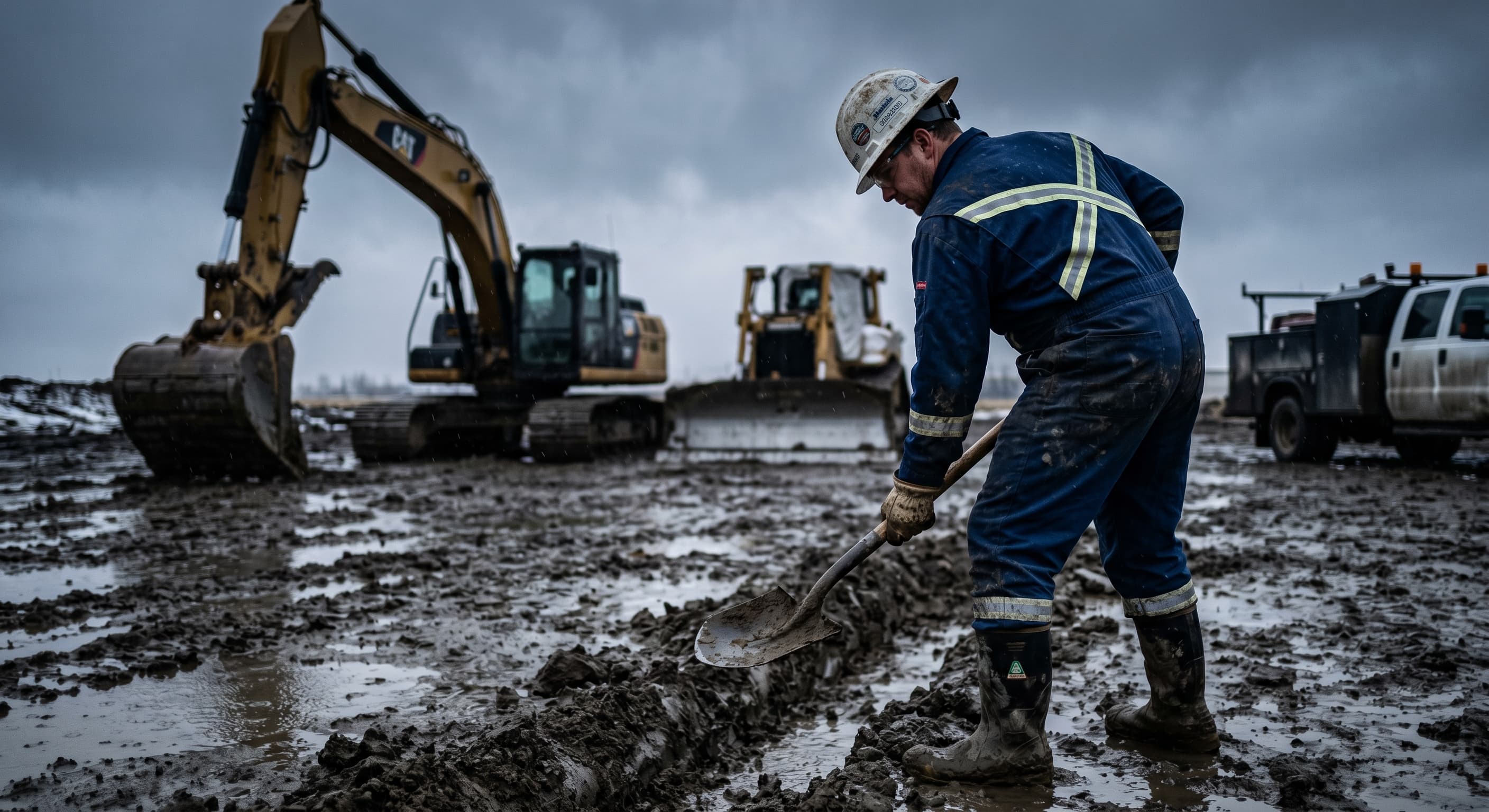
Spring breakup hits oilfield leases differently than a construction site: road ban weight restrictions, soft lease roads, and a production schedule that will not wait. Here is what to plan for before the thaw.
Spring breakup does not follow a calendar. It follows the frost table, and on oilfield leases across Alberta and Saskatchewan the window between when a road can still carry a loaded unit and when it turns into a mud pit can close in a matter of days. Lease access is governed by its own pressures that a general spring construction checklist does not cover: road ban orders that change allowable axle weights with little notice, lease roads that were never built to municipal standard, and a production schedule that does not pause just because the ground softened.
This post stays specific to oilfield leases rather than general spring maintenance. If you need a broader seasonal facility checklist, that is a separate topic on this site. Here the focus is on what shows up when heavy equipment, lease roads, and thawing ground meet: weight restrictions, access planning, bogging hazards, and the scheduling problems all three create for inspections and deliveries.
Road bans and weight restrictions: know before you load
Alberta and Saskatchewan both issue seasonal road bans on provincial highways as frost leaves the ground, and municipalities layer their own restrictions on top for secondary roads, grid roads, and range roads that lease traffic actually uses to reach site. These bans reduce the allowable weight per axle for a defined period, and timing is regional. One county can post restrictions while a neighbouring municipality has already lifted its ban, and a wet spring can reverse that within a week.
- Check both the provincial highway restriction listing and the specific rural municipality or county map for the actual route, not just the highway number.
- Confirm ban status before dispatching, not the morning of. Restrictions can be posted or lifted quickly once conditions change.
- Know which loads are exempt or permitted under overweight authorization in your jurisdiction, and do not assume a permit from last season still applies.
- Communicate weight limits to third-party carriers and trucking contractors directly. A dispatcher working off an outdated ban list is a common source of overweight violations.
An overweight unit on a restricted road is not just a fine. On a softened road surface it is also a direct contributor to rutting, road failure, and a stuck or rolled vehicle. Weight compliance during breakup is a safety control, not only a regulatory one.
Site access planning before the thaw
The best time to plan lease access for breakup is before breakup starts. Once a lease road is saturated, options narrow fast and decisions get made under time pressure, which is when access planning turns into ad hoc problem solving on site.
- Walk or drive lease roads while they are still frozen to identify low spots, culvert crossings, and grades that pond water as the thaw progresses.
- Confirm which leases have all-weather access and which are fair-weather only, and flag the fair-weather leases for schedule adjustment ahead of time.
- Identify a turnaround point before the soft section, not after it, so a driver who meets an impassable stretch is not forced to reverse a loaded unit on a narrow lease road.
- Coordinate with landowners and other operators sharing the same access road, since one user's rutting becomes every user's hazard.
If a lease road has a known soft spot every spring, treat it as a standing hazard on the site's hazard assessment rather than re-discovering it each year. A documented access plan travels with the site file and does not depend on one supervisor's memory.
Mud and equipment bogging hazards
Bogging is more than an inconvenience. A stuck unit on a lease road creates a blocked route for other traffic, a recovery operation with its own hazards, and often a rushed decision to bring in a second heavy unit to pull the first one out, which can put a bigger machine at risk in the same soft ground.
- Assess ground conditions at the specific point of travel, not just at the lease entrance. Frost can leave the surface first while the base underneath is still saturated.
- Set a clear threshold for when a lease is closed to non-essential traffic until conditions firm up, and put someone with the authority to make that call.
- Have a documented recovery procedure, including who is authorized to attempt a pull, what rigging is acceptable, and when to call a dedicated recovery contractor instead.
- Keep workers clear of tow lines and rigging under tension during any recovery attempt. A snapped line or shifted anchor point during a bog-out is a serious injury hazard on its own.
Scheduling inspections and deliveries around breakup
Breakup season is exactly when field inspections, COR audit site visits, and equipment deliveries tend to collide with the least reliable roads of the year. A field inspection that can normally happen on short notice may need to be planned days ahead once access becomes conditional on the weather.
- Build a breakup contingency into the inspection schedule rather than treating a missed visit as a one-off. If a site is fair-weather access only, plan the inspection cadence around that reality up front.
- Stage non-urgent deliveries to avoid moving loaded units onto leases during peak thaw, and sequence deliveries by road condition rather than by requisition date alone.
- Keep a current access status list across all active leases so dispatch, field staff, and anyone booking a site visit are working from the same information.
- Flag any site visit or delivery that cannot be rescheduled and treat it as a higher-risk activity requiring a specific access and recovery plan, not a routine trip.
Building breakup planning into the safety program
None of this needs to live as tribal knowledge held by whoever has worked the area longest. Seasonal road and site access hazards belong in the hazard assessment and, where applicable, in the site orientation for anyone travelling to the lease during breakup. Field crews recording daily conditions and access status through a digital form makes that information available to dispatch and supervisors in real time instead of after the fact.
On-Track Safety Solutions works with oilfield operators and contractors across Alberta, British Columbia, Saskatchewan, and Manitoba on field safety programs and documentation that hold up through seasonal conditions like breakup.
Need a seasonal update before the thaw sets in?
Our field safety services and digital safety forms can help put your hazard assessments and access plans where your field teams can actually use them.
Talk to a safety advisor