COR and SECOR get requested on nearly every prequalification form in Western Canada, but few owners can say what the certifications verify or who issues them. Here are the basics, province by province.
If you have spent any time bidding on construction, oilfield, or municipal contracts in Western Canada, you have run into the letters COR and SECOR. Prequalification portals ask for them, prime contractors require them, and WCB premium statements reference them. Yet a surprising number of business owners cannot say precisely what the certifications verify, who actually issues them, or why the requirements look different depending on company size.
This post covers the fundamentals: what COR and SECOR are, who administers each certification in Alberta and in the other provinces On-Track serves, and the basic eligibility line that separates the two programs. A follow-up post covers how to decide which one fits your business and what the audit process involves. Here, we are sticking strictly to definitions.
What COR Actually Certifies
COR stands for Certificate of Recognition. It is not a government licence and it does not certify individual workers. It certifies that a company has a documented health and safety management system in place, that the system is actually being used on the ground, and that both facts have been confirmed by an external audit against a recognized standard.
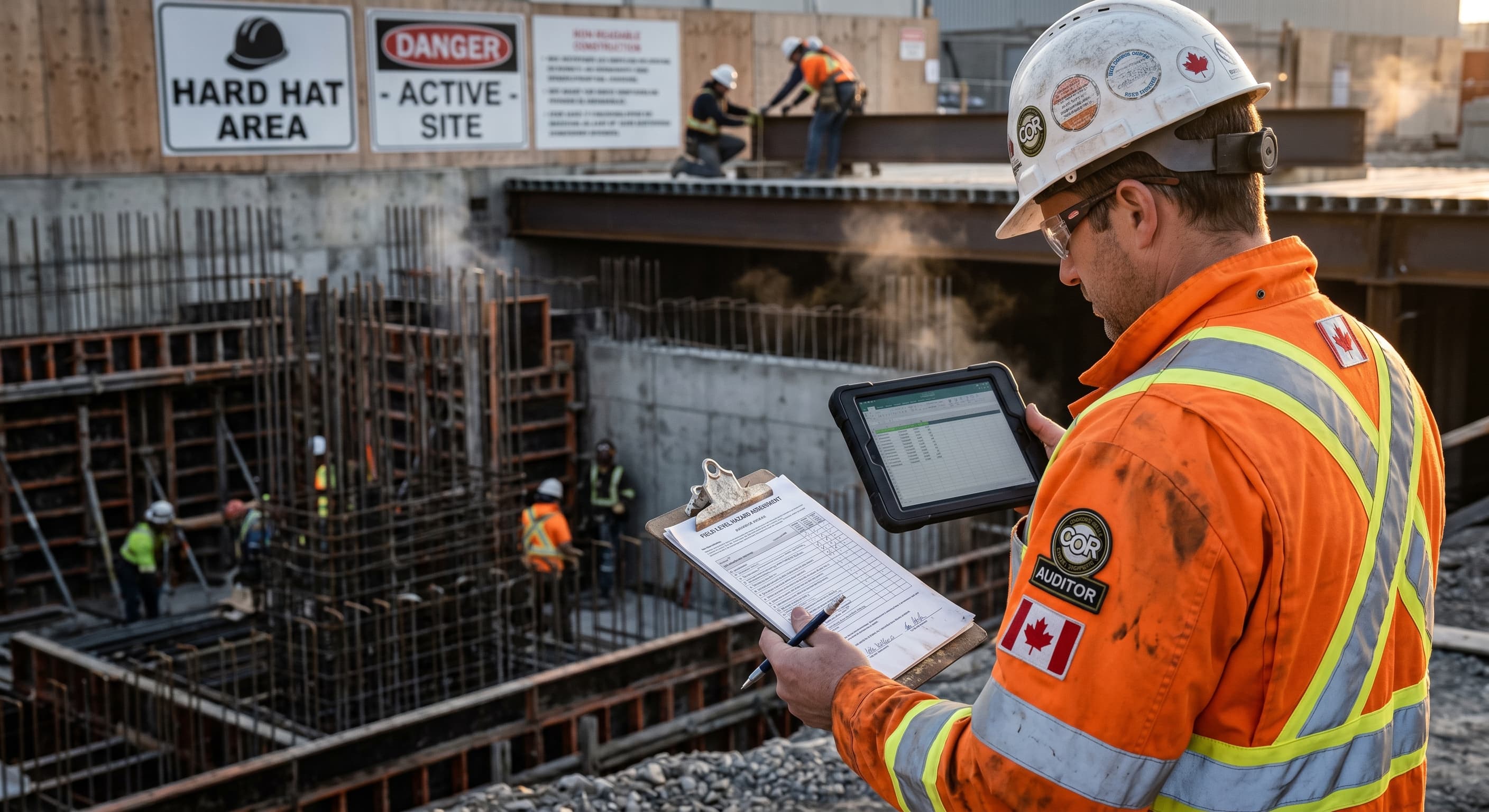
A COR audit examines written policies, such as hazard assessments, incident investigation procedures, orientation records, and inspection logs, alongside field evidence that those policies are followed day to day. An auditor registered with the relevant certifying partner conducts the audit, scores it against a standardized set of questions, and submits the results for certification. COR is typically maintained with an annual internal audit and undergoes a more thorough external audit on a multi-year cycle set by the certifying partner.
What SECOR Is, and How It Differs From COR
SECOR stands for Small Employer Certificate of Recognition. It is built on the same underlying safety management system elements as COR, but the audit is scaled and simplified for companies that are too small to reasonably staff and document a full COR-level program. In most jurisdictions, including Alberta, the general threshold for SECOR eligibility is a company with 10 or fewer workers, though the exact worker count and how it is calculated is set by the certifying partner and can vary by sector.
The core difference is not the standard being measured against, it is the scale of the audit and the size of the organization it is designed for. A one-person operation or a small crew is not expected to produce the same volume of documentation as a 200-person contractor, but both are expected to demonstrate the same basic commitment to identifying hazards, training workers, and investigating incidents.
Worker count for SECOR eligibility is usually based on average or peak employment over the audit period, not a snapshot on a single day. Confirm the exact calculation with your certifying partner before assuming you qualify.
Who Administers COR and SECOR in Alberta
Alberta does not have a single body that issues COR and SECOR. Certification is administered through sector-specific certifying partners, each of which trains and registers its own pool of auditors and sets its own audit schedule within the provincial framework.
- Alberta Construction Safety Association (ACSA) administers COR and SECOR for construction-sector employers.
- Energy Safety Canada (ESC) administers COR and SECOR for employers working in oil and gas.
- Alberta Association for Safety Partnerships (AASP) administers COR and SECOR for a range of other industries, including trucking, manufacturing, and general service sectors.
Which certifying partner applies to your business depends on the industry classification your work falls under, not simply which one you would prefer to deal with. A company that does both oilfield construction and general trucking work may need to confirm with more than one partner which classification governs its certification.
Certifying Partners Outside Alberta
On-Track works with clients across Alberta, British Columbia, Saskatchewan, and Manitoba, and each province runs its own certifying partner structure under its own workers compensation board. The certifying partner in your province is the body that trains auditors, sets the audit standard, and issues the certificate, in the same way ACSA, ESC, and AASP do in Alberta.
If your company operates across more than one province, do not assume a COR issued in one jurisdiction automatically satisfies a client's requirement in another. Reciprocity exists in some cases through national COR alignment, but the certifying partner in the province where the work is being performed is generally the one whose requirements matter for that contract. Confirm reciprocity directly with the certifying partner rather than assuming it applies.
Why the Administering Body Matters, Not Just the Certificate
Because COR and SECOR are administered provincially and by sector, the certifying partner is also the body that sets your audit cycle, approves your auditor, and reports your certification status to your workers compensation board. That reporting matters financially. In Alberta, WCB's Partnerships in Injury Reduction program pays employers the highest of three rebate calculations, up to a cap of 20 percent of premiums, tied to maintaining certification, improved safety performance, or below-average claim costs. SECOR-certified employers are eligible for the same rebate structure as COR-certified employers, there is no separate, lower rate for SECOR.
Other provinces run their own incentive programs tied to the same certifications. WorkSafeBC pays a rebate under COR, WCB Manitoba runs a Prevention Rebate program, and Saskatchewan currently has no direct COR-linked rebate, with the benefit instead flowing indirectly through experience rating. The mechanics of each incentive program are enough to fill their own article. The point for this post is simpler: because the certifying partner reports your status to the WCB, getting the right partner and the right certification type from the start avoids delays in both your contract prequalification and your premium adjustments.
The Basic Takeaway
COR and SECOR both verify the same underlying thing, a functioning safety management system backed by evidence, not paperwork sitting in a binder. The certificate you pursue and the body that audits you against it depend on your province, your industry sector, and your worker count. Before you start building or updating a safety program for certification purposes, confirm which certifying partner actually governs your business. Getting that wrong is the most common reason companies waste time preparing for the wrong audit.
On-Track Safety Solutions has been building and auditing safety management systems for Western Canadian employers since 2008. If you are unsure which certifying partner applies to your business or what a COR or SECOR audit will actually look at, our team can walk through your specific situation.