Insights
Who Needs a SECOR Certificate in Alberta?
SECOR (Small Employer Certificate of Recognition) is the occupational health and safety certification stream designed for employers with 10 or fewer workers in Alberta. It audits the same safety management system elements as full COR, uses a simplified tool scaled for small operations, and qualifies the employer for the WCB Partnership in Injury Reduction premium rebate of up to 20%.
Published 13 May 2026 · The On-Track Team
7 min readKey Takeaways
- In Alberta, SECOR applies to employers with 10 or fewer workers -- employers above that threshold must pursue full COR.
- SECOR audits the same safety management system elements as COR but uses a simplified tool and smaller sample sizes scaled for small operations.
- A valid SECOR certificate qualifies Alberta employers for the WCB PIR rebate of up to 20% of annual premiums -- often more than the audit costs.
- The pass threshold is 80% overall and at least 50% in every element; a single low element score is a hard fail regardless of the overall total.
- SECOR operates on a three-year cycle -- external initial audit, two internal maintenance audits, then an external recertification audit.
- Energy Safety Canada offers cross-jurisdictional SECOR audits covering Alberta, BC, and Saskatchewan under a single engagement.
1. What SECOR actually is
SECOR stands for Small Employer Certificate of Recognition. It is a formal third-party verification that a small employer has built and is running an occupational health and safety management system that meets a defined audit protocol. The certificate is issued by the provincial Workers' Compensation Board and audited by an accredited certifying partner chosen by the employer.
SECOR uses the same audit framework as full COR. The same elements are scored: policy, hazard assessment and control, safe work practices and procedures, training and orientation, inspections, incident investigation and reporting, emergency response, records and statistics, and program administration. The difference is that the audit tool and sample sizes are scaled for small operations. An employer with five field workers does not need the same documentation volume as a company with 200.
For small employers, SECOR carries the same weight as COR on most prime contractor prequalification platforms, ISNetworld, Avetta, and ComplyWorks. Holding a valid SECOR certificate signals to hiring clients that the company runs a managed safety program -- not just a binder on a shelf.
2. Who qualifies in Alberta
In Alberta, SECOR is the correct certification stream for employers with 10 or fewer workers. Employers with 11 or more workers must pursue full COR instead. The worker count is based on the number of employees covered by the safety program, not necessarily the total company headcount or payroll. Part-time workers, seasonal employees, and owner-operators working in the field are typically counted.
The industries that most commonly hold SECOR in Alberta include small construction contractors, electrical and mechanical service companies, landscaping and grounds maintenance businesses, small oilfield service operators, agricultural employers, and any other small employer where site work creates meaningful OHS exposure. The threshold is a worker count, not an industry restriction -- any Alberta employer under 10 workers can pursue SECOR.
Employers that regularly fluctuate above and below the threshold -- for example, a company that has 8 workers most of the year but adds seasonal help -- should discuss the situation with their chosen certifying partner before the audit begins. The partner will confirm which stream is appropriate based on typical operating conditions.
3. The WCB PIR rebate
Alberta's WCB Partnership in Injury Reduction (PIR) program rewards employers that hold a valid COR or SECOR certificate with a rebate on their annual WCB premium. For employers in the SECOR stream, the rebate is up to 20% of the WCB premium assessed for that year. The certifying partner submits confirmation of a valid certificate directly to WCB Alberta; the rebate is applied automatically without a separate application.
The rebate is not simply for completing the paperwork. It reflects the documented relationship between formal safety management and reduced workplace injury rates. Employers holding SECOR tend to produce fewer WCB claims over time, which is why the program exists and why WCB Alberta is willing to pay the rebate. For a small employer paying $15,000 per year in WCB premiums, a 20% rebate returns $3,000 -- often more than the cost of the initial audit.
To qualify for the rebate, the SECOR certificate must be in good standing at the time WCB calculates premiums. Lapsing the certificate -- by missing a maintenance audit or failing a recertification audit -- removes the rebate eligibility for that year. Staying current on the 3-year cycle is what keeps the rebate flowing.
4. The four-step certification process
Getting SECOR certified follows the same four-step process across all provinces, though the certifying partner and training format vary. Understanding the process upfront prevents the two most common delays: starting the audit before the program is implemented, and choosing a certifying partner that does not serve the company's industry or prime contractor platforms.
- 1Choose a certifying partnerThe right partner depends on the industry, the province or provinces where work is performed, and which contractor management platforms the company is registered with. Some partners are sector-specific. Others, like Energy Safety Canada, audit across multiple provinces under one engagement. The partner also provides internal auditor training, so the relationship matters beyond the initial certification.
- 2Complete internal auditor trainingThe employer designates someone -- often the owner or safety lead -- to complete the certifying partner's internal auditor training. This training covers the audit protocol, scoring, and how to conduct maintenance audits in years two and three of the cycle. Most certifying partners offer this in a one or two-day format.
- 3Build and implement the safety programThe safety management system must be documented and actually running before the audit happens. Written hazard assessments, safe work practices, training records, inspection logs, and an incident investigation process are among the core elements. The audit looks for evidence that the program is in use -- not just written.
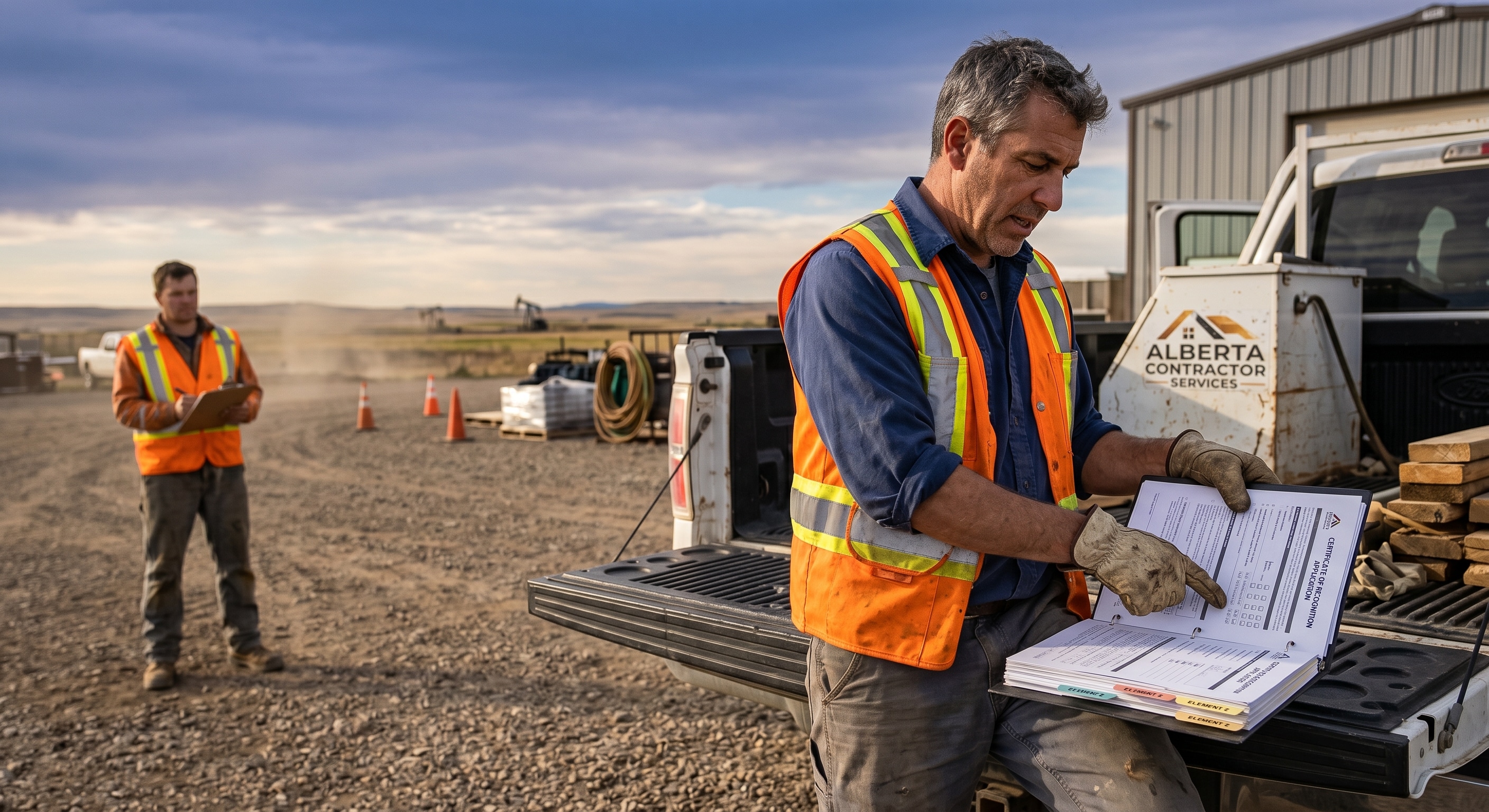
- 4Complete the external auditThe initial certification audit is always conducted by an external accredited auditor. The auditor scores the program against the protocol, interviews workers, reviews documentation, and may conduct a site visit depending on scope. The audit produces a scored report and corrective action plan. A score of 80% overall and at least 50% in each element results in certification.
Start generating field records at least three months before your audit
5. Scoring and passing
The SECOR pass threshold is consistent across certifying partners: 80% overall and a minimum of 50% in each individual element. Both conditions must be met. An overall score of 85% does not pass if any single element falls below 50%.
Each audit element is scored by reviewing the written documentation, examining the records produced by the program, and in some cases interviewing workers or observing work in progress. The elements that most commonly produce scores below 50% on a first audit are hazard identification and assessment, inspections, and incident investigation -- all three of which depend on ongoing field activity, not just written policies.
The most effective way to prepare for a first SECOR audit is to start generating records at least three months before the audit date. Written policies are necessary but not sufficient. The auditor needs to see that the policies have been used: completed hazard assessments, signed inspection logs, toolbox talk records, training sign-offs, and investigation reports where applicable. A company with clean, current field records will almost always score well above the 80% threshold.
Audit score trend
3-year cycle
6. The three-year certification cycle
SECOR is not a one-time certificate. It operates on a three-year cycle that requires ongoing audit activity to maintain. Understanding the cycle structure is important because missing a maintenance audit can lapse the certificate and remove the WCB rebate.
In Alberta, year one is the initial certification audit, conducted externally by an accredited auditor. Years two and three typically use internal maintenance audits, conducted by the person the employer trained as an internal auditor. The recertification audit at the end of year three is again external. This structure is consistent across most certifying partners, though the exact requirements vary by partner.
The internal audit in years two and three is not a formality. It uses the same scoring protocol as the external audit and must achieve the same 80% overall / 50% per element threshold. The certifying partner reviews the internal audit results. A weak internal audit may trigger a corrective action requirement or a request for external re-audit before the certificate is renewed.
The practical implication for small employers is that the safety program cannot be built once and left alone. Ongoing inspections, toolbox talks, updated hazard assessments for new work types, and current training records are what keep the internal audit score at a level that maintains certification.
7. SECOR in other provinces
SECOR is not exclusive to Alberta. British Columbia, Saskatchewan, and Manitoba all have small employer certification streams operating under the same basic framework. The worker thresholds, certifying partners, and WCB rebate structures differ by province. Employers working across multiple provinces should confirm which stream and certifying partner applies in each jurisdiction before beginning the process.
Alberta
- Worker threshold
- 10 or fewer workers
- WCB rebate
- Up to 20% WCB PIR premium rebate
- Notes
- Multiple certifying partners depending on industry sector.
British Columbia
- Worker threshold
- 19 or fewer workers
- WCB rebate
- Lesser of $1,000 or 75% of WCB premium
- Notes
- BC calls the program Small COR. WorkSafeBC administers rebates.
Saskatchewan
- Worker threshold
- 9 or fewer workers
- WCB rebate
- WCB rebate (amount varies by year)
- Notes
- SCSA, HCSAS, and ESC are the main certifying partners.
Manitoba
- Worker threshold
- Varies by certifying partner
- WCB rebate
- 15% rebate or up to $3,000 (maximum 50% of premiums)
- Notes
- SAFE Work Manitoba administers the program.
Energy Safety Canada (ESC) offers multi-province SECOR audits that cover Alberta, British Columbia, and Saskatchewan under a single engagement. For small employers working across those three provinces, an ESC audit eliminates the need to manage separate certifications in each jurisdiction.
Ontario does not have a separate SECOR program. Small employers in Ontario can access the WSIB Health and Safety Excellence program (HSEp), which has a different structure and is not directly equivalent to SECOR. Employers with cross- provincial operations that include Ontario should confirm the right certification path with their certifying partner.
Our Services
Ready to scope your SECOR audit?
On-Track Safety conducts SECOR audits for small employers across Western Canada. Costs depend on the age of your safety program, whether this is an initial or renewal audit, and the provinces in scope.
See SECOR audit details8. Frequently asked
What is the worker count threshold for SECOR in Alberta?
In Alberta, SECOR applies to employers with 10 or fewer workers. Employers with 11 or more workers must pursue full COR. The worker count is based on the number of employees covered by the safety program, not the total company payroll. If a company regularly fluctuates above and below the threshold, the certifying partner will advise which stream applies.
Can a SECOR certificate be used in multiple provinces?
Energy Safety Canada (ESC) offers a cross-jurisdictional SECOR audit that covers Alberta, British Columbia, and Saskatchewan in a single audit. If a company operates across those provinces and is eligible for SECOR in each, ESC can audit all three under one engagement. Other certifying partners issue province-specific certificates that are not automatically transferable.
How much is the WCB PIR rebate for SECOR in Alberta?
The WCB Partnership in Injury Reduction (PIR) program in Alberta offers a rebate of up to 20% of the employer's annual WCB premium when a valid SECOR certificate is maintained. The exact rebate amount depends on the employer's injury experience and the rebate structure for the year. The certifying partner provides confirmation of certification to WCB, which applies the rebate automatically.
How long is a SECOR certificate valid?
A SECOR certificate is issued on a 3-year certification cycle. In Alberta, the initial certification audit is external (conducted by an accredited auditor). Maintenance audits in years two and three of the cycle are internal (conducted by a company employee trained by the certifying partner). The recertification audit at the end of the third year is external again.
What score do you need to pass a SECOR audit?
The standard SECOR pass threshold is 80% overall and a minimum of 50% in each individual audit element. An overall score above 80% will not pass if any element scores below 50%. Both conditions must be met. Elements typically include policy, hazard assessment and control, safe work practices, training, inspections, investigations, emergency response, and program administration.
What is the difference between SECOR and COR?
COR and SECOR audit the same occupational health and safety management system elements against the same basic protocol. The difference is size. SECOR uses a simplified audit tool designed for small employers with 10 or fewer workers in Alberta. The scoring thresholds are the same (80% overall, 50% per element). The audit scope and sample sizes are adjusted for smaller operations. Both carry the same WCB PIR rebate eligibility and both are recognised by most prime contractor prequalification platforms.