Most employers have the individual pieces of a safety program. Fewer have them connected. Here is how policy, hazard assessment, training records, inspections, and incident investigation are supposed to work as one system, not five separate binders.
Walk into most Western Canadian worksites and you will find a safety manual, a stack of field level hazard assessments, a training matrix, an inspection checklist, and an incident report form somewhere in a filing cabinet or a folder on a shared drive. Individually, none of that is unusual. Almost every employer has some version of each piece.
What separates a program that passes a COR or SECOR audit from one that does not is rarely the existence of these documents. It is whether they actually connect to each other. An auditor, and more importantly a worker relying on the program, should be able to trace a straight line from a written policy down to what happens on the ground, and back up again when something goes wrong. This post walks through that line, piece by piece.
The policy is the floor everything else is built on
A safety manual is not a document you produce once for an auditor and shelve. It sets out who is responsible for what, what standards apply to the work you actually do, and how the organisation expects hazards to be identified and controlled. Every other piece of the system, from hazard assessment forms to training requirements, should trace back to something the manual commits the organisation to doing.
This is also where a lot of programs go sideways: a manual that was purchased or copied from a template and never adapted to the employer's real scope of work, real equipment, or real site conditions. If your manual describes procedures for work you do not perform, or omits hazards you deal with every day, the rest of the system has nothing solid to build on. On-Track builds and maintains manuals specific to the employer's actual operations rather than generic templates (see our safety manuals service at /services/safety-manuals).
Hazard assessment is where the program meets the work
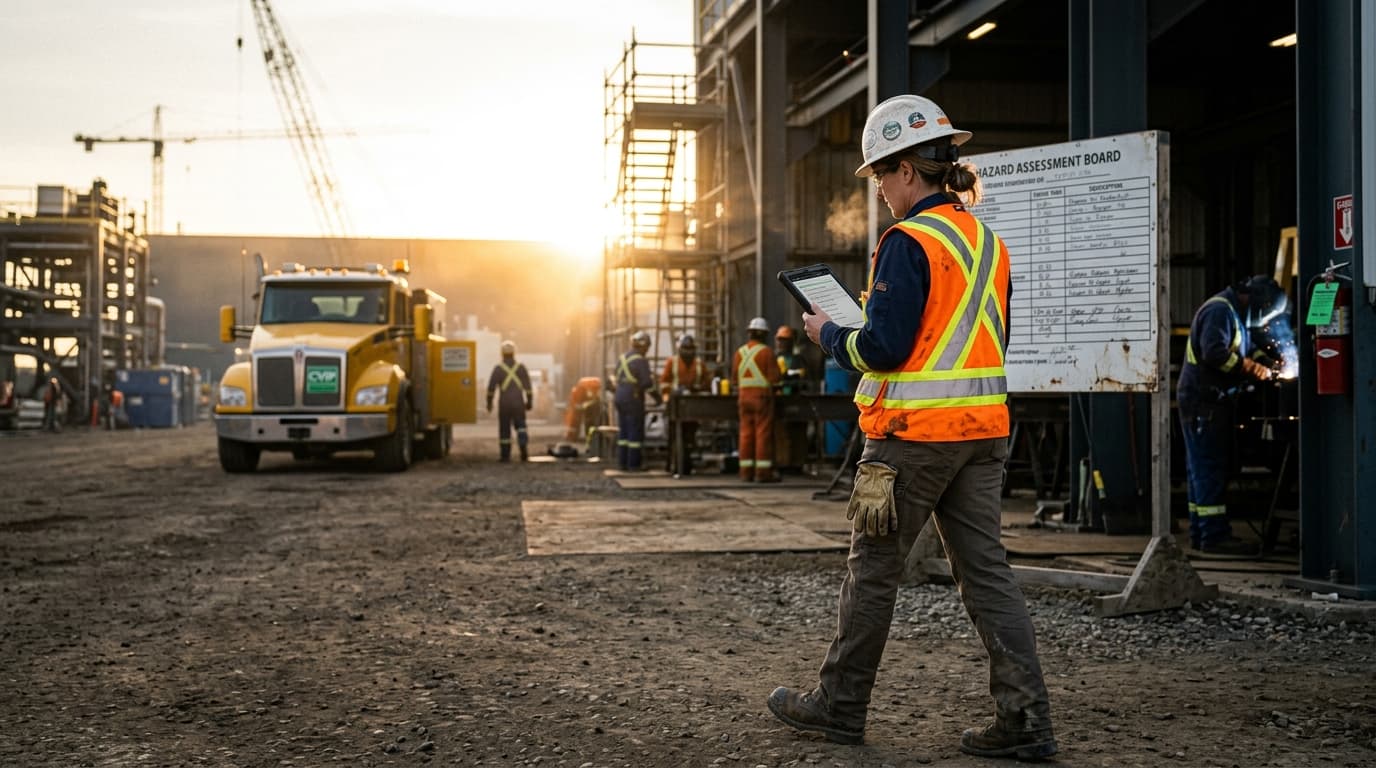
A field level hazard assessment, or FLHA, is completed before a task starts and identifies what could go wrong on that specific job, that day, in those conditions. It is the point where the general commitments in the manual get applied to a specific piece of work: a confined space entry, a lift near an overhead line, a task involving a chemical covered under WHMIS 2015.
The FLHA is not just a form to fill out and file. Its findings are supposed to drive two other pieces of the system: what training a worker needs before doing that task, and what an inspector should be checking for when they walk the site. If the hazard assessment identifies fall exposure but nobody checks whether the crew has fall protection training, or whether anchor points are being inspected, the assessment was paperwork rather than a control. On-Track's field safety services support employers in building and reviewing these assessments against the work actually being done (/services/field-safety).
Training records prove the assessment was acted on
If a hazard assessment says a task requires specific training, whether that is WHMIS 2015, working at heights, or equipment-specific instruction, the training record is the proof that the requirement was met before the worker was exposed to the hazard. An orientation record for a new hire and a training matrix for an existing crew serve the same purpose: they show that competency was established, not assumed.
This is one of the most common gaps we see in an audit. The FLHA correctly identifies a hazard, but there is no training record showing the worker who signed that assessment was actually qualified to control it. Training has to be tracked against the hazards identified in the field, not just against a generic new-hire checklist. On-Track supports this connection through online training modules and custom orientations built around an employer's actual hazards (/services/online-training and /services/custom-orientations).
Inspections verify the controls are still working
A hazard assessment and a training record establish that a control was put in place. An inspection confirms it is still there and still working weeks or months later. Guardrails get removed for a task and not replaced. Fire extinguishers get moved. A piece of equipment that passed its last check develops a fault. Regular, documented inspections are how a program catches drift between what was planned and what is actually happening on site.
Inspection findings should feed back into the system in both directions: a deficiency gets corrected and tracked to closure, and a pattern of recurring deficiencies should prompt a look at whether the original hazard assessment or training was adequate in the first place. An inspection checklist that never changes, no matter what keeps turning up, is not doing its job.
A hazard assessment that identifies a fall-restraint requirement is only as good as the training record proving the worker completed fall-protection training, and the inspection record proving the anchor point was still rated when the worker tied off.
Incident investigation traces back through every other piece
When something does go wrong, whether it is a near miss or an actual injury, the investigation is where the whole system gets tested at once. A thorough investigation does not stop at what the worker did in the moment. It asks whether the hazard was identified in the FLHA, whether the required training had been delivered and documented, and whether recent inspections had flagged anything related. Corrective actions coming out of an investigation often mean updating the hazard assessment template, adding a training requirement, or changing what an inspection checks for.
This is the loop that makes a program a system instead of a collection of forms. Policy sets the expectation, hazard assessment applies it to the work, training proves competency, inspection verifies the control is holding, and investigation catches what slipped through and feeds corrections back into the other four pieces.
Where certifying bodies and clients actually look for the connections
A Certificate of Recognition (COR) audit, or a SECOR audit for smaller employers typically with ten or fewer workers, is built to test exactly these connections rather than just check that each document exists on its own. In Alberta, COR and SECOR are administered through certifying partners such as ACSA for construction, Energy Safety Canada for oil and gas, and AASP, with other provinces running their own certifying partners. Alberta's WCB Partnerships in Injury Reduction program pays a premium rebate for maintaining COR, up to a capped 20 percent depending on performance, and other provinces run comparable incentive programs, such as WorkSafeBC's 10 percent COR rebate or WCB Manitoba's Prevention Rebate. On-Track supports employers through both COR audits and SECOR audits (/services/cor-audits and /services/secor-audits).
Contractor prequalification platforms such as ISNetworld, ComplyWorks, Avetta, and CanQual apply the same logic from a client's perspective before they will award work to a contractor. They are not just checking that a policy exists, they want to see that hazard assessments, training records, and inspection records line up with the work the contractor is actually being hired to do. On-Track helps employers manage and maintain these accounts (/services/contractor-management).
Keeping the pieces connected day to day
The hardest part of this system is not designing it once, it is keeping the pieces linked as crews change, jobs change, and paperwork accumulates. Paper-based systems tend to drift apart because a hazard assessment sitting in a truck and a training matrix sitting in an office rarely get compared to each other. Digital platforms such as SiteDocs, which On-Track is an authorised referral partner for, and a centralised members portal help keep hazard assessments, training records, and inspection results in one place where the connections can actually be checked, rather than assumed (/services/digital-safety-forms and /services/members-portal).
If you are building or rebuilding a safety program, the goal is not five strong individual documents. It is one system where each piece is built to feed the next, and where an auditor, a client, or your own supervisor can follow the line from what your policy commits to, down to what actually happened on a specific job site.